For those of us who grew up taking music lessons, the Suzuki name is most likely ubiquitous. Though you probably don’t know much about the man himself. If you’re not familiar with Suzuki or his method, this book is a fascinating first step into the world of Suzuki Method. In this post, I’m sharing a breakdown of this 2022 biography as well as my favourite takeaways. I believe it’s a must-read for anyone interested in early childhood education. (All page numbers are for the paperback edition.)
*For your convenience, here is a link to Suzuki: The Man & His Dream to Teach the Children of the World from Amazon. Know that as an Amazon Associate I earn from qualifying purchases.*

The Author: Eri Hotta
I don’t know much about Eri Hotta, however, I believe that nobody else could have written this biography. Her personal connection to the subject material – growing up in Japan, being interested in the violin and later having her daughter take violin lessons using the Suzuki Method – but especially her ability to translate primary sources herself makes this biography really special. Hotta also has a background in International Relations, which helps her give the book a very clear historical context. You don’t need to be familiar with Japanese history and politics to follow along – she paints the picture in detail and sets the scene.
Outline of the Book
After a brief introduction to the author, this biography opens with a famous concert put on by Suzuki’s violin students in 1955 that attracted world attention. We then go back in time and get a lot of historical and political context for Japan when Shinichi Suzuki’s father first started making violins at the end of the 19th century, which is the jumping off point of the narrative. To be expected, this biography follows Suzuki’s life chronologically. I will admit that I thought the very detailed descriptions of what was going on in Japan politically and economically seemed a bit tedious at first. But once I realised that Suzuki was actually a visionary education reform activist, not just a violin teacher, it all started to click.
I won’t waste your time by trying to summarise such a well-written book. I will only highlight the parts of the book that stood out to me as an educator and as the mother of a Suzuki Method student (soon to be students). Assuming you’re a fellow homeschooler who geeks out about all things related to education, I think you’ll find Suzuki’s thoughts on these topics quite interesting…
- The Purpose of Education
- The Definition of “Talent”
- The Importance of Environment
- Similarities Between the Philosophies of Suzuki and Montessori
The Purpose of Education
Hotta cites Suzuki’s own education as having a profound impact on his philosophy. Similar to Classical Education, “he [Suzuki] came to appreciate that the purpose of education is not the cultivation of specific skills … but instead the development of morally upright individuals (p 46)”.
The first school at which Suzuki taught violin when he needed a job during Japan’s economic depression of the 1930s was referred to by the abbreviation Teion. Similar to Suzuki’s own school growing up, Teion’s goal was “to strive for the nurturing of character, as well as true musicianship (p 107).” Additionally, “its institutional principles dovetailed with the Bildung spirit that Suzuki had relished in Berlin: the conviction that art and culture could aid in a never-ending process of moral and intellectual improvement (p 107).”
Thus, even the first music school Suzuki taught at focused on the education of the person as a whole being, not simply the training of a musician in the skill of a musical instrument. This philosophy of education is the backbone of what the Suzuki Method is – an approach to education of the whole child, not just in the training of the violin. The violin is simply a way to educate the person. It is not an end goal in itself. And this echoes the Platonic idea that music education can help form a student’s moral character.
Defining “Talent”
One idea that made Shinichi Suzuki unique, even among people claiming to support his method of education, was his definition of “talent”. I love that Hotta goes into detail about the translation of the Japanese word for “talent” and its close relationship to the word “genius”. Suzuki believed that every child possesses talent. That it is NOT some gift of heaven (the actual Japanese definition of “genius”) that someone either possesses or doesn’t. Hotta explains that there are other words in Japanese that Suzuki could have used to mean something like “potential”.
However, “Suzuki was aiming for something more when he redefined talent as the manifestation, via learning and practice, of noryoku soshitsu, “innate potential” or “raw aptitude”. These were inborn, while talent came to those who stretched their latent potential through nurture and effort. And the reason it was so important that talent be thus redefined was that Suzuki believed existing notions of talent were harmful to children…Students who believed in their own talent were at risk of becoming egotists, and parents who believed in their children’s talent became obsessed and hypercompetitive (p 146).” Suzuki believed that “no child should ever be called a genius in music or in any other pursuit (p 146).”
The life of one famous young violinist in particular at this time was a cautionary tale. That of Nejiko Suwa. She was labelled a “genius” and her family was eventually torn apart because of the ramifications of that label. And yet, even she still “had to put in the work (p 112).” When somebody makes a skill look effortless, we are tempted to say it’s because they are talented – implying that we could not do that same skill because we are not talented. As if “talent” in a specific skill is some thing one either has or has not, not something one can learn. Suzuki thought differently. And he taught hundreds of children in order to prove just that – playing beautiful music on the violin is something ANY child can LEARN how to do. Because every child has talent.
The Importance of Environment
Throughout the book, it is clear that Suzuki believed a child’s home environment had a very significant impact on that child’s talent in music. Each student of Suzuki’s who would go on to be labelled “talented” or even “genius” had one thing in common: growing up in a household full of music. Either the parents played themselves or they played recordings of beautiful, classical music.
“To Suzuki, this was a resounding affirmation that nurture was decisive in developing a child’s musical ear. An ear for music was like an ear for a language, and just as primary language acquisition was the opposite of exceptional, so too was musical ability…Anyone could be musically able if provided the right early exposure, under the encouragement of a caring adult (pp 123-24).”
“Anyone could be musically able if provided the right early exposure, under the encouragement of a caring adult.”
Montessori Similarities
This emphasis on the importance of a child’s environment in shaping their music career reminds me so much of what Maria Montessori believed about the importance of a child’s environment. As someone who has read Montessori’s books extensively, the similarities between Montessori’s and Suzuki’s philosophies of early childhood education are striking; if not wholly surprising, considering that they were contemporaries. In addition to the importance placed on the careful preparation of the child’s environment by a caring adult, other similarities include a rejection of prize-giving culture (p 141) as well as an emphasis on the importance of observation (p 202).
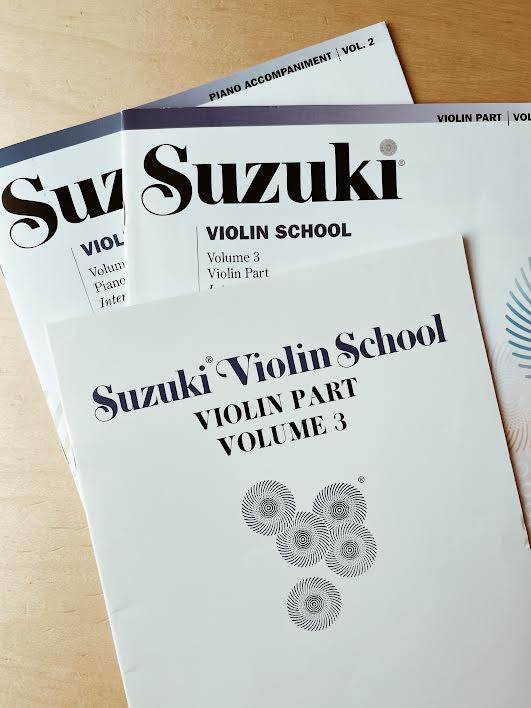
So what is the Suzuki Method?
Suzuki had a vision for education in Japan, especially a Japan looking to rebuild everything after being ravaged by World War II. The closest he ever came to seeing the Suzuki Method applied was a two-year stint at an elementary school starting in 1948. “The traditional curriculum – covering mathematics, science, the Japanese language, and so on – was set aside. Instead, in a relaxed and playful atmosphere, the students took part in various projects intended to train memory, concentration, motor and computational skills, and creativity. Suzuki had a close hand in devising these projects: drawing lines, painting with vivid watercolors, memorizing through storytelling and music, observing nature, feeling music through rhythmic exercises. The hope was that, by joyfully developing basic cognitive faculties, the children would gain the foundation necessary for any other form of learning (167).” If this doesn’t sound similar to a Montessori classroom – even down to the focus on learning to draw a straight line – I don’t know what would.
What started out as an all-encompassing philosophy of education by a man obsessed with the topic of early childhood development, became diluted to the point of being simply a method of studying a musical instrument. What is truly incredible to me about both Shinichi Suzuki, and to a lesser extent, Maria Montessori, is that it does not matter how good the results are. It does not matter how well children do with these approaches to education. The powers that be simply do not want to change and adapt. People do not want to invest in children. Not if it requires doing something outside the norm.
A story is told of a first grader in the aforementioned Suzuki Program who was intellectually slower than her peers, not being able to count to three when she arrived in elementary school. “By embedding skill-based learning in fun games, her teacher Tanaka ensured that she was able to stay focused. She would eventually go on to pass a competitive high school exam (p 168).”
Conclusion
Although it is sad that a man’s life work to use the violin to educate children became transformed into a violin instruction method, this biography is a fascinating read. Even if you aren’t a geek for early childhood education, I’d recommend this if you are interested in Japanese history and culture, 20th century history, classical music and the violin specifically. The name dropping alone is amazing. I knew Suzuki had met fellow violinist Albert Einstein, but other notable connections include Toru Kumon (of Kumon Learning Center fame) and Masaru Ibuka (founder of Sony). And then of course there are the many famous musicians.
If you have also read this biography, I would love to hear your thoughts! What stood out most to you?
Keep Reading About…
Reviews of books on education: Climbing Parnassus, The Well-Trained Mind
Where to read more about Maria Montessori: Montessori Books for Parents
Balancing rigorous homeschooling with intense extracurriculars like music: How to Balance Homeschool and Extracurriculars
If you’re thinking about starting your student in a Suzuki string program, you’re going to want to know how to make a cardboard violin or viola or possibly even a cardboard cello.


Leave a Reply