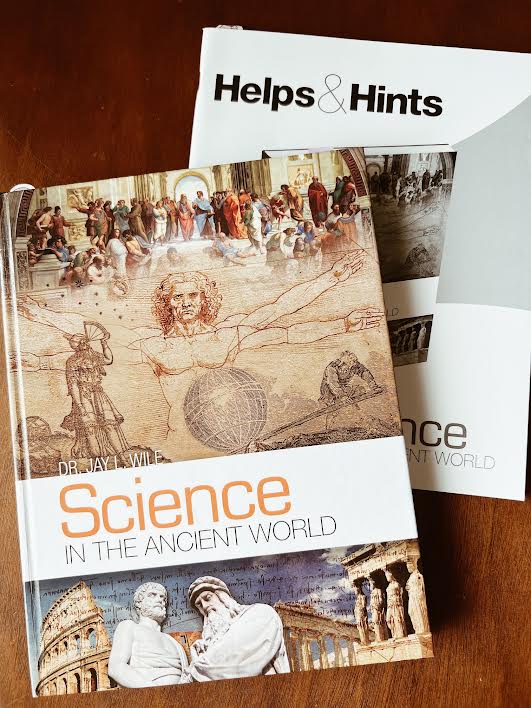
For my daughter’s second grade year, I combined three different science curriculums and this Berean Builders curriculum was the stand-out favourite for us. A chronological presentation of science combined with activities and experiments to illustrate the concepts in each lesson made this curriculum a winner for my science-loving student. This post is an in-depth review of Science in the Ancient World, the second book in the series.
*If you want to check out the book for yourself, you can use this Amazon affiliate link: Science in the Ancient World, just know that as an Amazon Associate I earn from qualifying purchases.*
Berean Builders “Science in the…” Series
Berean Builders Publishing was founded by Dr Jay Wile, the author of this elementary science series designed specifically for homeschoolers. Dr Wile’s publishing house includes curriculum for K-12 and the elementary level homeschool science curriculum looks like this:

I decided to skip ahead to Science in the Ancient World, the second book in the series, for my 2nd grader. Considering the fact that it starts in 625 BC with Thales, I didn’t think we’d be missing much from the first book. But I don’t know for sure because I’ve never looked at it. Ancient World has been a great place to start though. The level of understanding for the concepts introduced in this book has been very elementary-friendly.
Chronological Organisation
One of the main complaints of this textbook series is the jumping around among fields. I don’t see this as a con, especially at the elementary level. When students are still trying to get the big picture of science before they start to deep dive in the high school years, studying science chronologically makes so much sense. It’s its own history of science course and does a great job of showing how ideas come and go in the scientific community. Dr Wile even does a great job of addressing how science can be politicised and how difficult it can be for new ideas to be adopted, despite overwhelming evidence. Not only that, but the vary nature of jumping from field to field of science reinforces the fundamental principles among them.

What does Science in the Ancient World cover?
Every lesson in Science in the Ancient World includes about two pages of reading, an activity or experiment to illustrate the concept in the reading, and review questions that can be as easy or as challenging as you want to make them. For some lessons, the activity comes first and the reading builds on the student’s observations while other lessons have the reading followed by the activity. Either way, the activity is essential. This isn’t a bad thing, I just think it’s important to note upfront that there are no “easy days” with this curriculum. Every lesson requires prep. That being said, if you are truly prepared before class, one lesson never takes more than an hour. At least in my experience working with my second grader.
There are 90 lessons divided into 6 sections:
- Science Before Christ, Part 1 (Thales to Hippocrates)
- Science Before Christ, Part 2 (Plato to Hipparchus)
- Science Soon After Christ (Hero of Alexandria to Galen)
- Science in the Early Middle Ages (John Philoponus to Guy de Chauliac)
- Science in the Late Middle Ages (Nicole Oresme to Leonardo da Vinci)
- Science in the Early Renaissance (Leonardo da Vinci)
Of the 15 lessons in each section, 3 of them are marked as optional because of the advanced concept being taught. (And the materials required for those activities – listed in the front of the book – are also marked so it’s easy to plan ahead.) The author recommends doing science either 2 or 3 days per week and I can say that I agree this is a good pace.
These lessons cover the foundational scientific discoveries in the fields of Astronomy, Anatomy, Biology, Botany, Chemistry, and Physics. There might be more, but these are the main branches of science that I think you could group all of these lessons into.
Lesson Review
Each lesson ends with a Lesson Review geared towards three tiers of students. There are two questions for the “Youngest Students”, a notebook assignment for “Older Students” and a more in-depth follow-up to add on to the notebook project for “Oldest Students”. In other words, you can really build as much into this science curriculum as you want. If I decide to come back to this and cover it with an older student, we will definitely be making a notebook for things like definitions and a lab book to record observations of the experiments. That would easily flesh out this science curriculum and bump it up from second grade science to a whole other level.
For example, at the end of “Lesson 30: Hipparchus and the Sun and Stars”, you have the following:
Youngest Students
- What do we call the day on which the sun reaches its highest noontime point in the sky?
- If one star has a magnitude of 2 and another has a magnitude of 4, which appears brighter?
Older Students
In your notebook, define the winter solstice and the summer solstice. In addition, define the magnitude of a star, and make the distinction between apparent magnitude and absolute magnitude.
Oldest Students
Do what the older students are doing. In addition, there are specific names for when the earth is closest to the sun and when it is farthest from the sun. Do some research to find those names, and discuss how they are similar to apogee and perigee, which you learned about previously.
Activities & Experiments
Another reason we love this homeschool science curriculum is the many activities and experiments. The concept presented in each lesson is illustrated with either an activity or experiment to clarify what is being taught. Some require a few days notice to prepare material and there are notes in the textbook a few lessons ahead to warn you.
There are eight pages of supplies listed at the front of the textbook organised by lesson, with the optional lessons’ materials highlighted. There is also a good mix of simple activities and complex experiments. None of the materials are terribly exotic – and I can say that as somebody who doesn’t keep things like hydrogen peroxide regularly stocked in my bathroom cabinet. These materials truly are everyday objects. Not the “everyday objects” of a veteran science teacher.

Evaluation
In addition to the lovely hardcover textbook, you can buy the Helps and Hints booklet. While the author suggests using student notebooks to evaluate learning, especially at the elementary level, he does include tests (and test keys) for those teachers who need and/or want them. Each of the 6 sections listed above has its own 15-question test that includes multiple choice, true/false and comprehension questions. If you don’t test your elementary student, these questions can be used as a guide for reviewing key information with your student at the end of each section.
TLDR: Pros vs Cons
To sum up this Science in the Ancient World review, here are the pros and cons of this homeschool science curriculum:
PROS
- Quality colour photographs, including photos of the experiments as well as art.
- Chronological presentation of scientific discoveries gives students a solid big-picture context for studying science.
- Every lesson is hands-on. There are experiments or activities to illustrate the concept in every lesson.
- Lesson reviews for three levels of students make it easy to build on to this curriculum and meet the level of challenge appropriate for your student.
- Activity materials are actually everyday items. No ordering protozoa or lenses (or shopping for a microscope) with this curriculum. You can do this course on a budget.
CONS
- Requires prep. Most lessons are difficult to teach without the accompanying activity or experiment. So if you’re not well-prepared or don’t feel like making a mess one day, this isn’t the best curriculum to rely on.
- Minimal guidance for experiments and activities. The Helps & Hints booklet could have been more helpful to guide teachers through the experiments and activities. Some experiments can be tricky, so a more comprehensive teacher guide would have been nice.
Who would benefit from Science in the Ancient World?
- The student and teacher who enjoy history as much as science.
- The student who enjoys / needs hands-on demonstrations of science concepts.
- The teacher who is comfortable “jumping around” different fields of science.
- The teacher who enjoys teaching subjects chronologically and wants a science course that fits that approach.
Have you used this homeschool science curriculum? Anything you would add to this Science in the Ancient World review or any of the other Berean Builders science textbooks?
Keep Reading About…
More science curriculum reviews for second graders: Abeka Homeschool Science and Building Blocks of Science
How to do a science-heavy second grade school year: Second Grade Homeschool Science
Homeschooling chronologically, the Well-Trained Approach: Review of The Well-Trained Mind


Leave a Reply