Test grades are dropping. The whining or sighs start whenever it’s time to work on math. You know your student hates the subject and dreads having to get out his textbook. Every problem is suddenly “hard” and he has no idea how to do anything on his own. Your homeschooler is struggling with math. Where do you start?
Diagnostics: What exactly is the problem?
One of the key principles in a Montessori classroom is teacher observation. The teacher’s main job is to observe the students working. This is how they know the pulse of the classroom and how to adjust the environment to suit the students’ needs. As a homeschool mom, I use this principle all of the time. Less talking and more noticing. If you know your student is struggling with math, sit with him while he does his work. Don’t try to help unless he asks. Just watch his process. See where he gets hung up. Where do things start to spiral? Is it reading the lesson? Is it a certain type of problem?
Chances are, if you are sat next to your student doing his least favourite subject, you’re going to be asked for help. A lot. But make him lead. See if you can figure out exactly where he is getting frustrated. Let’s say it’s algebra. He’s staring at the problem in the book and tells you “I have no idea what to do!” So ask him, what are we trying to figure out? X? Ok, how do we get x by itself? Etc. Have him walk you through the steps as far as he can. Once you know what’s actually tripping him up, you can lean into it and double down until it’s easy: flashcards, workbooks like Kumon that focus on specific skills, etc.
If you can pinpoint that one concept that really confuses your student and focus on it until it is easy, you might just be able to change his entire perspective on math. He’ll see that even the scariest stuff can be easy if he puts in the work where it counts.
And if observing your student didn’t shed light on the issue right away, here are some common problems I’ve seen in my years as a high school math teacher and more than a decade of tutoring math and statistics.
Foundation Problems: Know Your Math Facts!
For elementary students (and even older students), a common problem I found when I was a tutor is that students do not have their math facts memorised. Parents have been told that rote memorisation is boring and uncool and that it will drain every ounce of creativity from your child! In preschool and kindergarten, it’s important for students to understand the concept of numbers. They should understand that the symbol 4 represents four countable objects. However, once a student grasps this concept, it’s time to start memorising those symbols. A 1st grader should not have to count objects when they are asked what 2 and 2 make.
When it comes to mathematics, rote memorisation is your friend, not the enemy!
As arithmetic progresses, students should not have to actively think through addition, subtraction, multiplication, and division. If they are having to stop and think (or worse, count on their fingers), then every math problem requiring one of these operations is going to take longer. Not only will it take longer, but it also increases the likelihood that the answer will be wrong. How frustrating is it to get most of the steps of a problem correct and realise you just added two numbers incorrectly?
So do your student a favour and require them to have their addition, subtraction, multiplication, and division facts memorised. Buy or make some flashcards and drill them until your student can fly through them. Even if you have to take a week off of your regular math textbook to do this, it’s worth it. Get sticker charts or a bribe involved. Whatever you have to do. If your student is slow at their math homework, this could very well be what makes all the difference.
Immediate Feedback is Critical
As homeschool mothers, we are incredibly busy and grading schoolwork can sometimes be put on the back burner, whether we mean to or not. But if your student is struggling with math (or any subject for that matter), please remember that immediate feedback is critical. Struggling through a math lesson and only finding out 2 or 3 days later that you missed most of the problems is not only discouraging, it’s useless. By the time your student gets his work back, he likely won’t remember why he solved the problem the way he did and why he got it wrong.
If you cannot sit with your struggling student while he works the lesson, the least you can do is grade and return his work the same day. The lesson should be so fresh in his mind that he can explain to you why he tried to solve the problem the way he did.
Penmanship: It’s More Important Than You Realise
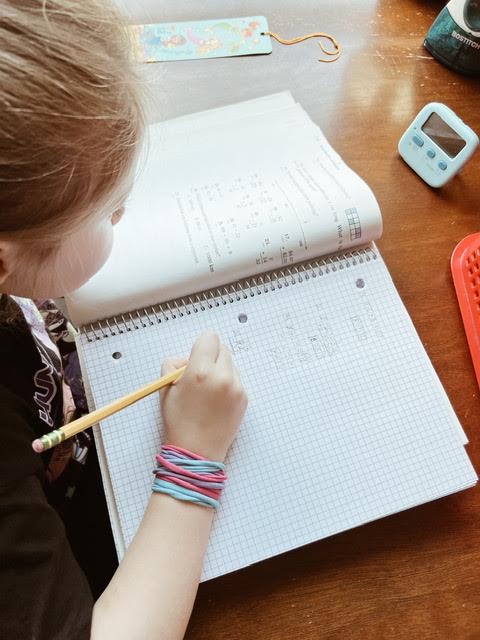
I noticed in my own daughter’s work that her penmanship was tripping her up more than her understanding. She could explain a concept correctly, but would often copy the numbers down so sloppy or not align them properly that she would get wrong answers. Once I saw how poorly she was writing her work, we switched to graph paper. Graph paper won’t immediately fix the problem, but it is a good start. Unless your student is just naturally neat and tidy, she will probably have to be shown how to leave white space and align digits properly. This is all part of the learning process. Take the time to teach your student how their work ought to look and why it is important to take care with their writing. Their writing should be legible. And it will make your job as the grader that much easier.

Consistency over Quantity
Mathematics, just like a musical instrument, takes practice. Daily practice. A student must practice mathematics daily. And no, Saturdays are not off-limits. If your student is really struggling, I would say putting in a few minutes on Sunday wouldn’t be a horrible idea either. Practicing consistently is more important than working for two hours on a problem set three days a week. And you better believe that taking an entire summer break from mathematics is not the smartest idea anyone ever had.
Timers to the Rescue
Sometimes, math is just overwhelming. Even if you understand the concepts, the amount of work required for a problem set can feel intimidating. When this happens to my daughter, I pull out the timer. Don’t worry about finishing a lesson to check a box (you can make up work on a Saturday if need be). Consistency is more important than checking a box for a completed lesson. I would rather my daughter give me a solid hour of her best effort and quit when the timer goes off than cry over a scary-looking problem set. Limiting math to a set amount of time helps take away the intimidation factor and can be a game changer when it comes to changing a kid’s perspective on the subject. It’s suddenly more manageable because it has a definite end time.
Caution about Switching Curriculum
If your student is seriously struggling, I know some might advise to switch curriculum. This can be a solution, but I want to suggest it be the solution of last resort. This is where you have all kinds of potential for gaps in a student’s instruction, since different publishers introduce certain math concepts at different grade levels. As a former math tutor who saw this kind of struggle all the time, I honestly think it’s better to choose a curriculum, stick with it, and simply use additional resources to make sure a student is understanding. In fact, I have an entire post on why you should be combining different homeschool math curricula.
When to Get Outside Help
Obviously, if you as the teacher are having a difficult time grasping the concepts well enough to explain them properly, you will need to look into hiring a tutor or outsourcing this subject to someone else. I will also add, as a mother, it doesn’t matter how well you understand the subject: if things get emotional, get a tutor. And I mean if you as the teacher get emotional. If you cannot explain the concepts without getting impatient or losing your temper, for the sake of your relationship with your child, it’s time to outsource it.
Need Personalised Math Support?
Sometimes a student does not need a completely different curriculum—they need a different explanation, more practice, or someone who can identify the specific gap that is holding them back. I offer one-on-one online math tutoring for homeschool students from elementary math through high school.
As a homeschool mom and experienced math educator, I understand the challenges of teaching math at home. I can work alongside your existing curriculum to help your student strengthen foundational skills, build confidence, and move past the frustration that often comes with struggling in math.
If your child is feeling stuck, falling behind, or needs a different approach to make math finally click, I would be happy to help.


Leave a Reply