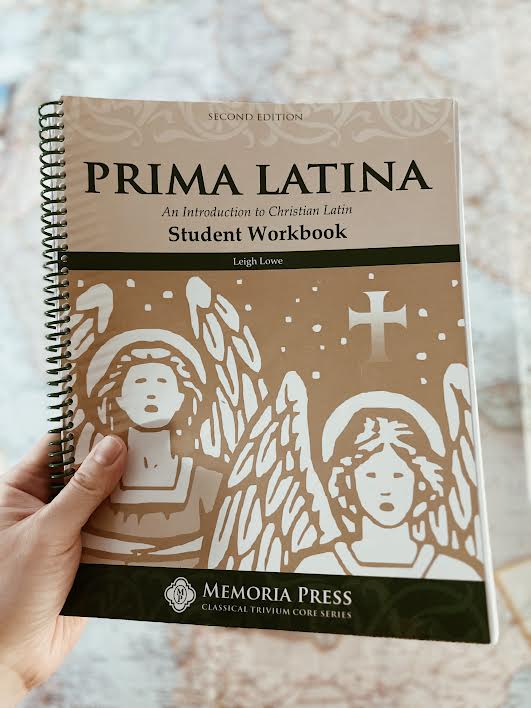
Third grade is the year we added Latin to our homeschool and what an adventure! Even though I studied Latin in school (Bob Jones University Press), it wasn’t until high school and I had already had a few years of French study under my belt. So, a completely different experience than my daughter starting the subject in third grade at age 6. This post is all about our experience using Prima Latina – the first Latin textbook from Memoria Press, suggested in their catalogue for 2nd grade. In a hurry? Scroll down for the TLDR section of this Prima Latina review where I bullet point the pros and cons. You’re welcome.
Why study Latin?
This is such a loaded question, and no, I’m not going to attempt to defend Latin as a course of study in this blog post. I do want to suggest though that if you are on the fence, to read Climbing Parnassus: A New Apologia for Greek and Latin. The author does a superb job defining Classical education as it has been understood throughout history and why Latin and Greek are pillars of that type of education. I was already convinced of the importance of studying Latin before I read the book, but I was still impressed with this author’s defence. I actually blogged about my favourite parts of Climbing Parnassus if you want the highlights.
Why Memoria Press for Latin?
The two main reasons I’m using Memoria Press for Latin, even though there might very well be other great programs is:
- (1) Memoria Press has a comprehensive scope and sequence, all the way through high school that sets up their students for AP Latin. It’s all thought out. If you start with Memoria Press, you can just follow the path.
- (2) I already use and love several other subjects from Memoria. Their teacher manuals are so incredibly boring – in the best way! They are all the same. It does not take long to get the hang of the routine they are setting up. And once you are in the routine, you can focus on the content and focus on teaching it well.
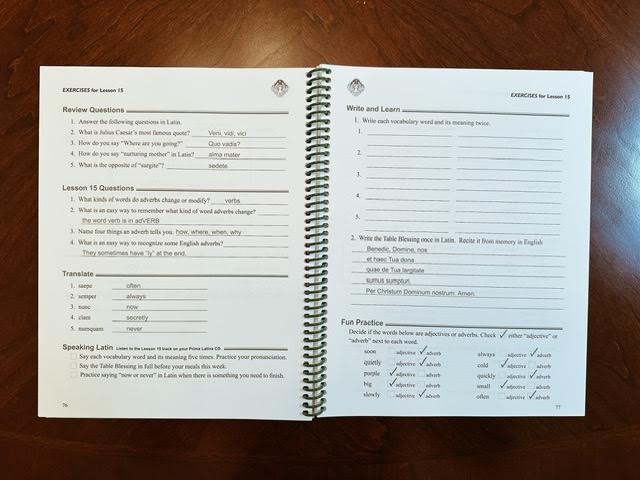
One thing I happened to notice in Christian Studies I this year really stood out to me and made me love Memoria Press all the more. If you use the curriculum or read my review, you know there are vocabulary words for each lesson in Christian Studies. Well, one of the vocabulary words one week was a derivative from one of the Latin vocabulary words in Prima Latina and they called it out. This is the beauty of a well-thought-out curriculum – making connections between subjects.
You do not need to know Latin to teach this! But it helps.
Since Latin is seeing a revival of sorts, there are a lot of parents teaching Latin today that did not have the opportunity to study it in school themselves. And I know the big question for a lot of people is thus “Can I teach this course if I don’t know Latin myself?” For Prima Latina, the answer is definitely yes. Does it help? Sure, it makes your life easier if you’re already familiar with the words and their derivatives. But learning it alongside (or the day before) your student is absolutely doable at this level with Prima Latina. To be upfront with you, I did study Latin in high school and have studied several languages since (Romance and non-Romance languages). So teaching Latin did not intimidate me. That being said, if I were seeing all of this vocabulary and terminology for the first time, it would not be overwhelming.
How to Pronounce a Dead Language: Ecclesiastical vs Classical
We paid for the Prima Latina kit from Memoria Press, meaning we got the video lectures with the course. My daughter enjoyed watching a teacher other than her mother and I liked the fact that she was hearing ecclesiastical pronunciation. That means that the prayers she is hearing pronounced by her Latin teacher via the Memoria Press video lectures will sound the same as she hears them at Mass.
The other Latin pronunciation is called Classical and is used by classical leagues around the country and other secular academic groups. I’ve heard people say it’s not a huge deal to switch if you’ve learned it one way. I’ve also heard people who learned the classical pronunciation say that ecclesiastical Latin sounds just like classical Latin with an Italian accent. So know the difference and know that it is a matter of preference. Think about your goals, your life, and where you and your student might also encounter Latin, then journey forth with confidence!
Curriculum Overview
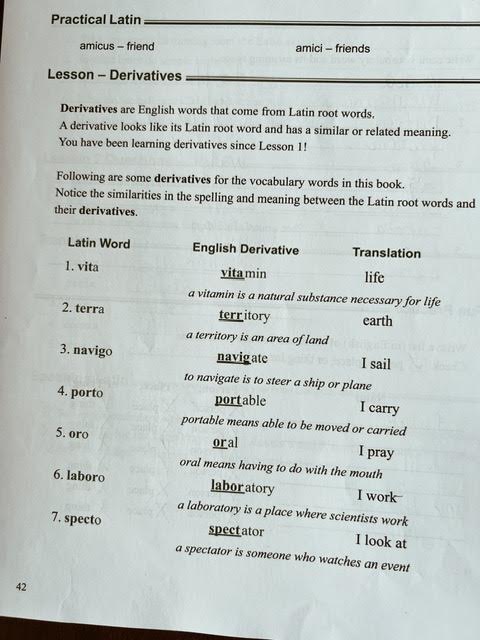
Like all the Memoria Press curriculum I have used so far, Prima Latina contains 25 lessons and 5 review lessons, making 30 weeks worth of material. What this looks like is 5 lessons – one lesson per week – followed by a review lesson. That review lesson gives you a week to review the previous 5 weeks’ worth of material before testing your student on it. This is one thing I love about the Memoria Press curriculum – how an entire week of review is scheduled before each test. And because this course is aimed at second graders, the tests (including the final exam) are not cumulative.
Students are learning the basics of grammar: the parts of speech. Assuming your student is simultaneously taking an English grammar course (we used Abeka’s 3rd grade English curriculum this year), there is quite a bit of repetition. And I don’t say that as a negative at all. The more reinforcement your student gets at this level, the better. These are quite literally the building blocks of languages. Seeing words like “verb” and “conjugation” in multiple courses during the school day is so helpful for building connections and understanding.
Verb Conjugations
Speaking of verb conjugations, if you are homeschooling in English and Latin is your first foreign language, the idea of verb conjugations might be new. Not the idea, but the terminology. Because I started teaching French so early, my daughter was already used to this term and this concept. And learning to associate different spellings of a verb with different subjects in Latin just helped reinforce this grammar topic for her. That being said, verb conjugation is only introduced near the end of the course. The majority of the vocabulary introduced in Prima Latina is nouns and there are only three verbs taught in their entire present tense form, and those are near the end of the book.
Noun Declensions
Also, by the last lesson, the student is just – ever so slightly – inroduced to the idea of declensions. The extent of it is that students should associate “conjugations” with verbs and “declensions” with nouns. I love that they just hinted at what was coming without actually teaching it yet. Yes, they ask the students to memorise a short list of noun endings (first declension). But that is really just so students have something concrete to associate with the idea of a declension. Prima Latina really does a great job balancing rigour with age-appropriate expectations.
Latin Prayers Included in Prima Latina
- The Sanctus
- The Gloria Patri (aka the Glory Be or Minor Doxology)
- The Table Blessing
- The Pater Noster (aka the Our Father or the Lord’s Prayer)
Lesson Format
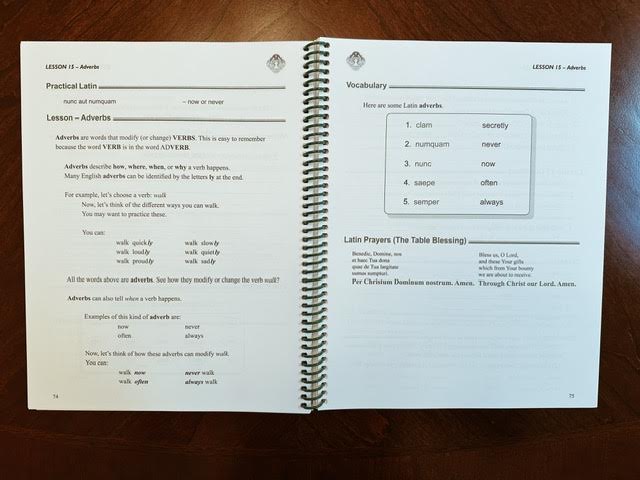
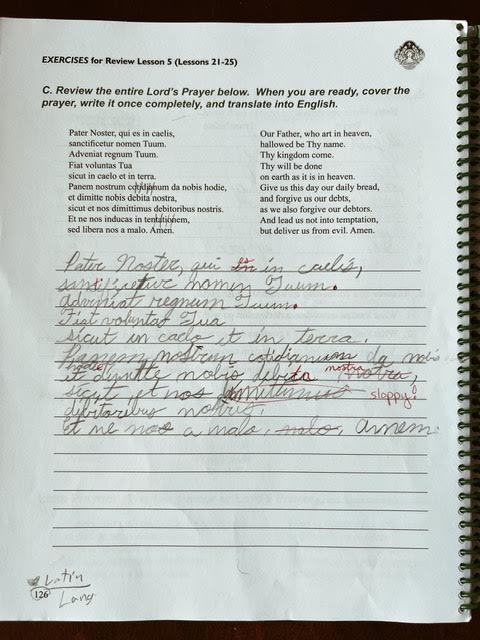
Each lesson (that is not a review lesson) introduces five vocabulary words, associated derivatives and a grammar point. There are two pages of simple exercises where students are asked to write translations for memory and copy their vocabulary words. There is also part of a prayer being memorised. Approximately one line of a prayer is worked on each week (each lesson).
The review lessons have a concise layout of all of the material taught in the previous five weeks. There are a few exercises to review material and an entire page to copy each vocabulary word, its translation and a known derivative.
Evaluation
Like I said above, the tests in this course are not cumulative, including the final exam. This is the only Memoria Press curriculum we have used so far that did not use cumulative exams. But I believe that is simply because Prima Latina is geared towards 2nd graders.
Students are expected to know the meanings as well as the correct spellings of the vocabulary words. It is also important to know the basic grammar being introduced – parts of speech, what a verb conjugation is, etc.
Despite the textbook asking students to copy the Latin prayers, the tests themselves are simply fill-in-the-blank. So if your second grader cannot recite the Pater Noster word-for-word yet, don’t worry. I wouldn’t say the bar is low, I would just say that it is age-appropriate for this course.
When to start Prima Latina? 2nd or 3rd?
In the Memoria Press catalogue, Prima Latina is suggested as a 2nd grade course and Latina Christiana suggested as enough material for both 3rd and 4th grade. I had already decided to start Latin in 3rd grade, but I chose to use Prima Latina specifically because it was a slower pace (5 vocabulary words per week instead of 10). My oldest daughter – my third grader and the Prima Latina student – was a young 3rd grader. She just turned 7 between first and second semester. So between the fact that she is young and Latin is already her third language, I was in no hurry to rush her through vocabulary. I wanted to make sure her foundation in Latin was built slowly.
And I believe that decision paid off, because she ended up really enjoying Latin. After science, it was her favourite subject. Latin was an easy course load for her and the video lectures – which she got to watch on my iPhone – made it all the more enjoyable. Now we get to start 4th grade Latin with good vibes. Since she is already used to a rigorous schedule, I’m not sure that Latina Christiana will take us two years, but you can check back for that review sometime around next spring.
For reference, the sequence suggested by Memoria Press is:
- 2nd Grade : Prima Latina
- 3rd- 4th Grade : Latina Christiana
- 5th Grade : First Form Latin
- 6th Grade : Second Form Latin
- 7th Grade : Third Form Latin
- 8th Grade : Fourth Form Latin & Henle Latin Series I
- 9th Grade : Henle Latin Series II
- 10th Grade : Caesar: Selections from his Commentarii de Bello Gallico
- 11th Grade : Henle Latin Series III
- 12th Grade: AP Latin
How we used Prima Latina in 3rd Grade
A sample week using Prima Latina looked like this:
Monday – My daughter would watch the video lecture for that week’s lesson, with the book by her side. She was getting an overview of the week and hearing the correct pronunciation.
Tuesday – She would just review her flashcards for that lesson (made by me the previous Friday when writing out my lesson plans). Flashcards take maybe a minute. Tuesdays were especially light for Latin and some weeks we skipped it altogether if we were really busy.
Wednesday – She would review her flashcards (5 vocab words, maybe a confusing grammatical term or two) and do a page of exercises in the textbook.
Thursday – She would review her flashcards for that week and do the second page in the textbook.
Friday – This was a review day. My daughter would review all the vocabulary flashcards since the last test. And this is the day that I would do the flashcards with her if time allowed. So that I could see how she was doing and what she was actually remembering.
Some weeks, I would use the light days to assign copy work. Her goal was to copy the Latin prayer of the week in its entirety in her neatest penmanship. We also would listen to them. Gregorian chant is something I like to keep on in the background during the school day quite often, but this year I made a point of listening to these specific prayers in Gregorian chant to help my daughter remember the words.
Reading this schedule, you will notice that Latin took minutes a day. The key was simply being consistent.
TLDR: Pros vs Cons
This Prima Latina review in a nutshell:
PROS
- Slow pace. I know some parents are intimidated by Latin. Prima Latina goes at such a slow pace (only 5 new words each week) that I don’t see how anyone could get overwhelmed. This is truly beginner friendly.
- The teacher does not need to know Latin. Everything is explained and defined. If you don’t get the full kit with the video lectures from Memoria Press, Google can easily pronounce the vocabulary if you type it in. So yes, this is absolutely teacher-doesn’t-know-Latin-friendly!
- Latin Prayers Prima Latina contains several prayers that you will recognise if you attend the TLM (Traditional Latin Mass).
- Reinforces English grammar. This Latin course teaches the parts of speech, so it’s a great review of English grammar while introducing Latin vocabulary.
- Age-appropriate evaluations. The tests for this course were not cumulative. They were just the right length to make sure your student can recall the vocabulary and grammar points.
CONS
- Not a lot of practice built in. I ended up having to make my own worksheets for my daughter to actually learn the Pater Noster by heart (personal goal – not one of the course objectives) and make sure she was spelling the more difficult vocabulary words correctly. An older student might be able to do more self-study, but a younger student would benefit from more directed practice activities.
Who would benefit from Prima Latina?
- Students and teachers pursuing a Classical education.
- The teacher who wants to introduce a foreign language slowly into her homeschool.
- The teacher who is intimidated by Latin but still wants to teach it.
- The teacher who wants to boost her student’s English vocabulary or support the study of a Romance (Latin-based) language.
- Catholic families who attend or are interested in attending the TLM (Traditional Latin Mass).
So is Prima Latina worth it?
Yes. For homeschool families wanting to take the plunge into Latin, I think Prima Latina is an excellent place to start your elementary student. Its gentle pace and emphasis on grammar fundamentals make it especially well-suited for younger students and parents who have never studied Latin themselves.
Let me know…
Are you interested in seeing the worksheets I’ve made for my kids to help them follow along during the Traditional Latin Mass? Leave me a comment and let me know!
Keep Reading About…
Foreign language courses from Memoria Press: First Start French I review
Climbing Parnassus book review – this book defines Classical education and elegantly defends the study of Latin
Other classical subjects from Memoria Press that we’ve used: Greek Mythology


Leave a Reply