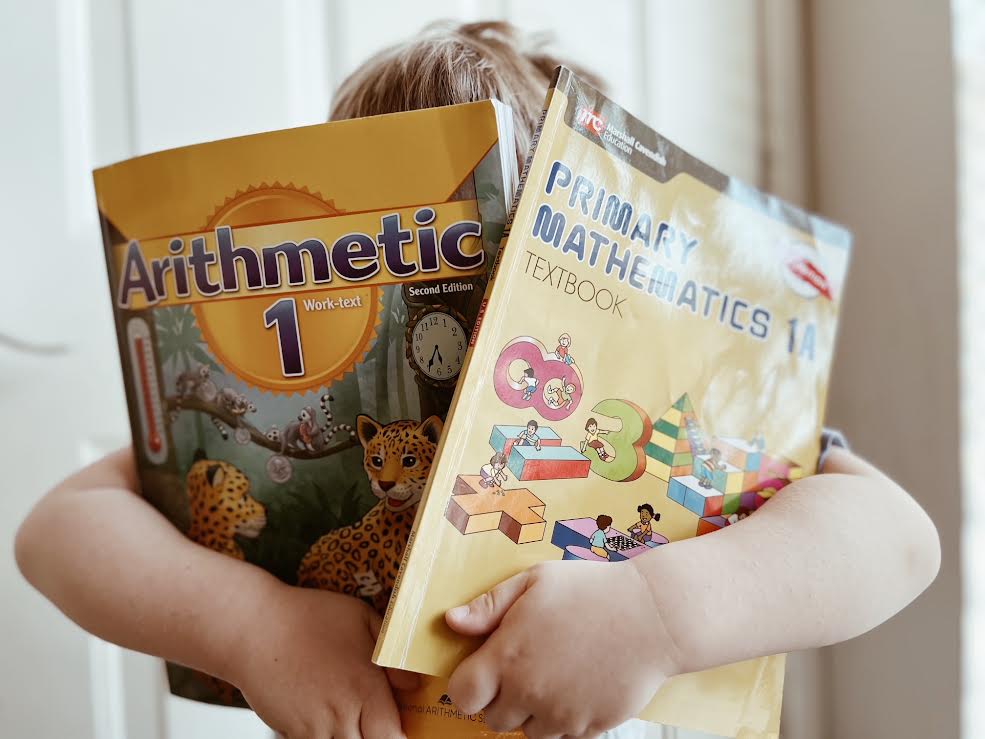
With my oldest, I used the Montessori method for preschool and early kindergarten, then went straight to Singapore’s Primary Math 1A because it was the most similar approach to what I had been using. It was the next logical step. But I ended up getting her Abeka’s Arithmetic 1 for extra practice and she fell in love with the book. It was fun and she just genuinely enjoyed doing the pages. Now with my second kindergartener, I’ve found myself again using Singapore’s Primary Math 1A and Abeka’s Arithmetic 1 simultaneously. So in this post I’m giving the run-down on why I like using them – the strengths and weaknesses of both. And why you might consider one over the other. Or do what I did and use both at the same time.
*For your convenience, I hyperlinked the books mentioned in this post to Amazon. Just know that as an Amazon Associate I earn from qualifying purchases.*
Wait, Kindergarten or First Grade?
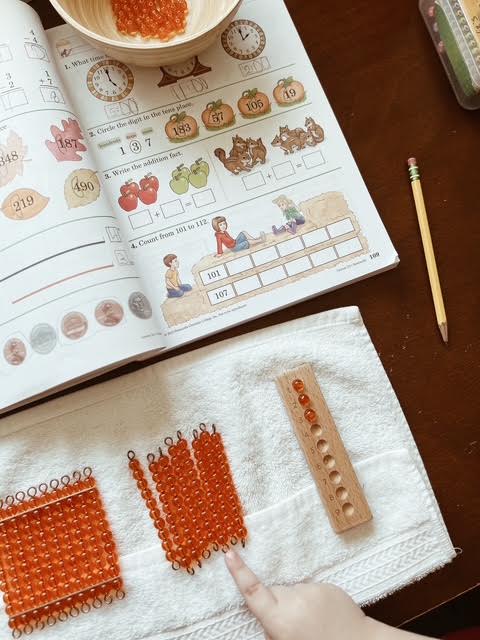
Both of my oldest kids (now 4th grade and kindergarten) took really well to the Montessori approach to numerical literacy. Number rods, sandpaper cards, the spindle box (the concept – I’ve used everything like dried pasta and paper bags), the golden beads, etc. These hands-on activities for teaching abstract concepts like place value have set a really solid foundation for my kids. So much so that both of them – despite one having Einstein Syndrome and the other not – both started what’s considered first grade math around the end of age 3. So when I’m comparing and contrasting these curriculum, just know that I’m working with 3 and 4-year-olds who are still barely able to write their numbers, even though they understand the material and can do the work.
Singapore Primary Math 1A & 1B
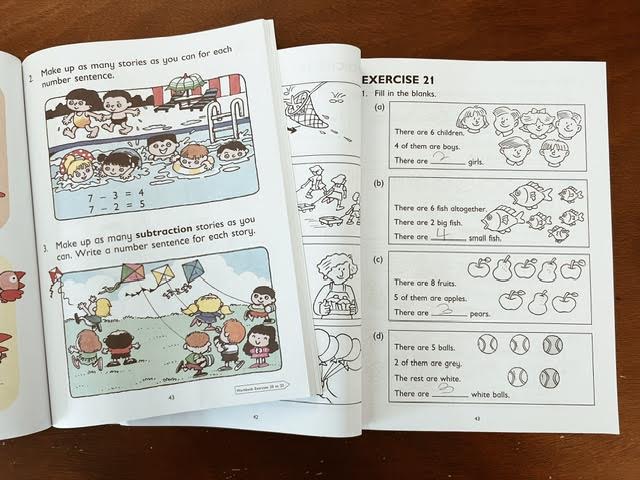
The Singapore curriculum can be confusing at first, so just to make sure you’re tracking, there are a few different versions of “Singapore math” books available in the US. Some are designed to meet Common Core standards in the US and there’s even one specifically for the state of California. I chose to use the edition that is the original Singapore curriculum with minor adjustments for the US, like currency and measuring system: Primary Mathematics U.S. Edition.
This curriculum uses the mastery approach, which means when a concept is first introduced, there is a lot of practice with that one concept. This is great, but then you don’t necessarily come back to it again. You master it, then move on. Of course, math builds on itself. But for things like measuring, or learning shapes, you’re going to learn that once and then not come back to it for a while. If at all.
One thing that the Singapore curriculum does really well is teaching math facts as number bonds. For example, a number bond is 5, 2, 3. There are four math facts for that number bond: 2+3=5, 3+2=5, 5-2=3, and 5-3=2. Notice that the student will automatically understand how addition and subtraction are related. Or that addition is commutative (the order of adding the numbers doesn’t change the sum). This is a great way to teach kids.
Pros
- Number Bonds – the Singapore approach to teaching math facts.
- If you’re on a budget and have multiple kids, the way the workbooks and textbooks are separate make it a lot cheaper. You can buy one textbook and multiple workbooks.
- Several ideas in the teacher guide for extra practice with concepts, including games. (Like playing the card game War to practice greater than vs less than.)
Cons
- In the curriculum, number bonds up to 10 are not taught gradually. Basically, you learn them all in 2 or 3 lessons and the teacher guide says to not move on in the book until your student knows them. I’m all for rote memorisation, but this was not helpful. This is when I pulled out the Abeka Arithmetic 1 book to do in the mean time.
- The aesthetic – workbooks are black and white and the illustrations are quite sloppy looking in my opinion.
Abeka’s Arithmetic 1
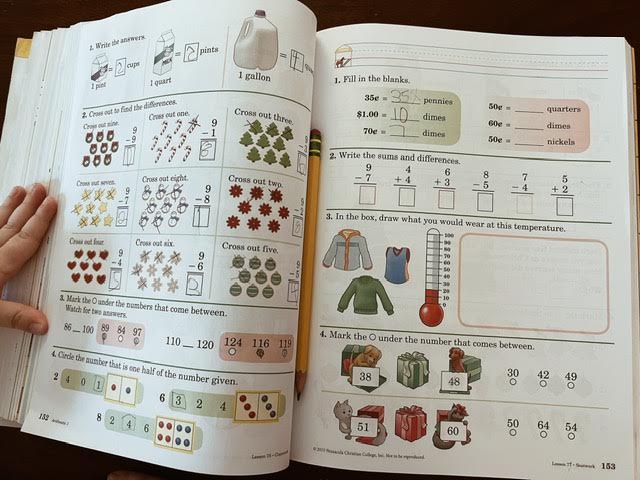
Abeka’s arithmetic textbooks use the spiral approach. As opposed to the mastery approach used in Singapore, concepts are introduced slowly, with not a lot of practice in that lesson in which they are introduced. But those same concepts consistently pop up again. So the student gets a lot of practice spread out over the textbook (spaced-repetition style).
Pros
- Math facts are taught gradually.
- Spiral approach means a lot of practice for all of the new skills spaced out over time.
- The aesthetic – colourful textbook with fun characters that my kids enjoy.
- The entire school year is in one textbook, which can be nice if you don’t want a lot of books to keep track of.
- You don’t need a teacher guide – it is super easy to just do a couple pages together and explain the new concepts as you come across them.
Cons
- Abeka textbooks are not cheap. I get around this in the early years by skipping the Teacher Guides. But just know that there are a few sections every once in a while that say things like “Write the answer to the combination your teacher gives” or “Write the number your teacher says”. If you’re comfortable making stuff up yourself, this isn’t a huge con.
How We Use Singapore AND Abeka Together
So how do we actually use two textbooks for math? I usually start with Singapore at the beginning of the year and then bring out the Abeka textbook when it’s time to learn the math facts (aka “number bonds”). Once the Abeka textbook is pulled out, my kids tend to like to get really far ahead in it. Between the pictures, the colouring pages, and the mix of things like reading clocks and thermometers, they just really enjoy it. And it can be hard to get back to the Singapore textbook. But when I feel like they are speeding too fast through Abeka Arithmetic 1, I’ll go back to the Singapore workbook for extra practice. Remember, this is our Kindergarten year that we’re using these books, so I’m not strict about lesson numbers. As long as math is being done every day, I’ve met my objectives.
Does it work?
Considering the fact that both of my oldest kids enjoy math and my 7-year-old daughter is doing 4th grade level mathematics, I count it as a success. Of course, it depends on what your goals are for your homeschool math classes. Every homeschooler’s definition of success will be different, but for me that’s (1) enjoyment, not intimidation of mathematics and (2) an accelerated pace that will allow my kids to reach the more fun mathematics courses before the end of high school. Combining math textbooks makes both of those possible for us.
Keep Reading About…
How we use the Montessori method in preschool
More math curriculum reviews: Abeka’s Arithmetic 3
My best advice for helping kids get ahead in math without burnout


Leave a Reply