For my eldest’s second grade year, I decided to lean into her favourite subject: science (and chemistry in particular). You can read about how we combined three different homeschool science curriculums. But today I’m breaking it down in full detail and writing up a more comprehensive Exploring the Building Blocks of Science homeschool review.
What is Building Blocks of Science?
I discovered this science curriculum in a Timberdoodle catalogue (if you homeschool and don’t get this, you’re missing out!) but it seems they don’t sell it anymore. It is, however, still available from several other online shops.
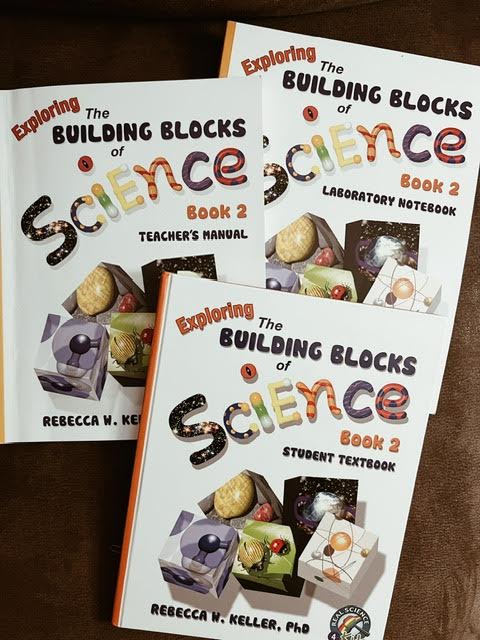
Exploring the Building Blocks of Science 2 (for second grade) can be bought individually or as a kit made up of a student textbook, a student laboratory manual and a teacher’s guide. It is considered a secular homeschool science curriculum. This doesn’t mean it conflicts with a Christian perspective. It simply doesn’t attempt to cover any controversial topics like origins or the age of the universe. Despite having an entire section on Astronomy, the textbook sticks to topics that actually fall within the domain of science: namely, what we can measure.
This is an experiment-heavy science curriculum that involves more time doing experiments and completing the laboratory notebook pages than time reading the textbook, which makes it a great option for students who prefer hands-on schoolwork.
What fields of science does it cover?
There are 5 main sections of this textbook covering the fields of:
- Chemistry
- Biology
- Physics
- Geology
- Astronomy
Within each of those sections are 4 chapters. Including the introduction and conclusion chapters of the textbook, that makes at total of 22 chapters. If you’re following a typical American academic calendar (approximately 36 weeks), then this can seem kind of light. However, for a busy homeschooler trying to juggle multiple grades and would like some buffer time to get through an experiment-heavy science curriculum, 22 chapters doesn’t sound bad.
Each chapter is an average of 6 pages of reading, with a lot of illustrations. If you’re using this for a second grader, then it seems like an appropriate amount of reading for the student. The first chapter for each of the 5 categories includes a short history of that particular field and some tools used by scientists in that field.
For each of those 22 chapters – including the introduction and conclusion of the textbook – there is a corresponding experiment (or sometimes just an activity).
Experiments from Building Blocks of Science 2
Truly, the highlight of this curriculum is the amount of rigorous (though pricey) hands-on activities and experiments. It takes quite a bit of preparation and not a little bit of money to follow through with all 22 of the experiments (1 for each week / each chapter) and the two pages worth of materials required to carry them out. However, if you have a student who loves science and you’re trying to fuel that fire, then this curriculum is great for that.

And this is where the Laboratory Notebook and the Teacher Manual come in. The lab book is for students recording observations from their activities. There can be a lot of writing for a young second grader, but you do have a week to read the minimal textbook pages and then do the experiment and fill in the notebook. So it’s definitely doable.
The Teacher Manual is basically just for walking you through the experiments. The beginning of the book organises all of the materials needed, first by lesson and then by type of material (e.g., foods, household items, equipment, etc). There is also a 2-page spread explaining what to look for when buying an affordable but good-quality microscope for a student. Compared to other teacher manuals I’ve bought in the past, I believe this one is not only useful, but absolutely necessary if doing the activities.

Outline of Experiments & Activities
- Chemistry: Activities include making a crucible, making red cabbage juice to act as an indicator to test for acids and bases, exploring properties of acids and bases, and learning how molecules determine flavours.
- Biology: This is the section that requires the use of a microscope. Activities include learning how to record observations, observing protozoa in pond water move, observing protozoa eating, and growing mold.
- Physics: The most simple of the experiments, but they reinforce foundational rules of physics. Activities include measuring time, learning about how mass responds to friction, calculating speed, and learning about rotational motion.
- Geology: Activities include learning about the tools of geologists, learning how to record weather observations and the weather’s effects on plants as well as animals.
- Astronomy: This section involves building a real telescope (you have to order the lenses), tracking constellations, modelling an orbit, and exploring the relationship between luminosity and distance.
TLDR: Pros vs Cons
This Building Blocks of Science review can be boiled down to the following pros and cons:
PROS
- Experiments. Actual experiments for the most part and very few science-y activities.
- Helpful teacher manual with steps for working through the experiments and activities as well as a list of the required materials thoughtfully organised.
- Laboratory notebook. Having a lab notebook just makes this science course feel more legit. It also gets the student more actively learning instead of just passively reading a textbook.
- Topics covered stay in the realm of science – what we can actually measure. So this is a great “secular” homeschool science curriculum (in the truest sense of the word) that doesn’t conflict with a Christian worldview.

CONS
- Cheap aesthetic. The cartoon illustrations instead of photographs, even when profiling scientists, looks cheap and juvenile. When you’re spending a lot of money on a textbook (about $140 for the set of 3 books, as of 2025), it’s pretty disappointing.
- Pricey. Not necessarily the textbooks themselves, but the materials required to do the experiments can get very expensive, especially if purchasing a microscope. And if you don’t invest in a microscope, that’s an entire 1/5th of the book that you’ll have to skip the experiments for. Which kind of defeats the purpose of using this curriculum, in my opinion.
Who would benefit from Building Blocks of Science?
- The kinaesthetic learner who needs a lot of hands-on activities and minimal textbook reading to understand abstract concepts.
- The precocious or gifted student with a keen interest in science.
- The homeschool mom who loves to teach science and has the time and budget for interesting experiments.
Have you used this 2nd grade science curriculum? What would you add to this Building Blocks of Science review?
Keep Reading About…
Other Science Curriculum Reviews: Abeka Homeschool Science Review
How we combine science curriculums at home: 2nd Grade Homeschool Science Review


Leave a Reply