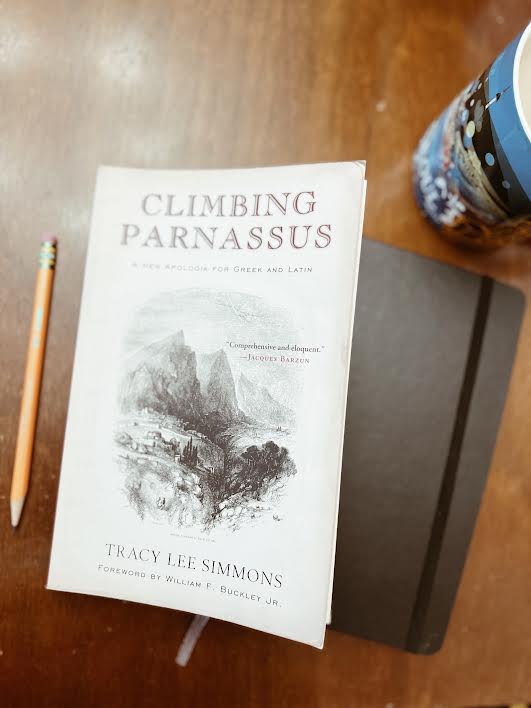
Climbing Parnassus: A New Apologia for Greek and Latin by Tracy Lee Simmons is an insightful defence and concise history of classical education as it has been understood from its inception. In this post, I mention some of the points and quotations that struck me most while trying to persuade you to read this book, whether you’re in the classical camp or not.
Definitions
Thanks to books like The Well-Trained Mind and Dorothy L. Sayer’s speech The Lost Tools of Learning, the definition of classical education today is a bit muddled. When homeschoolers say they are pursuing “classical education”, it could mean anything from studying history chronologically to dabbling in Latin. Neither of which is classical education as it has been defined throughout history. In Climbing Parnassus, Simmons hits the ground running with very clear and historically accurate definitions of “classical education” and its related vocabulary: “liberal arts”, “humanities” and even “culture”.
To be clear, classical education is mainly defined by its content. (This book does not focus on methodology.) In terms of content, a classical education consists of the study and mastery of Latin, Greek and the culture and history of Rome and Greece.
“Once classical education pointed to an elite course of instruction based upon Greek and Latin, the two great languages of the classical world. But it also delved into the history, philosophy, literature, and art of the Greek and Roman worlds…”
History of Classical Education
Simmons traces the history of classical education from its origin – the Romans studying the Greeks – all the way up through America’s Ivy League accepting the elective course system in the mid 19th century. Up until that point, education was clearly defined in the sense that every properly educated person had a very similar education. But when electives were introduced, two people could be awarded degrees and have vastly different university experiences.
Democracy would ensure that we all got what we wanted, not what we needed.
I also didn’t realise that knowledge of Latin and Greek used to be the ENTRANCE requirements for Harvard, William & Mary, Yale or Columbia. It would be a gross understatement to say the bar has fallen. At this point, it’s six feet under.
Purpose of Classical Education
If you read a book like The Well-Trained Mind (yes, I will pick on this one because I have actually read it multiple times), you’ll hear the oft-given argument for Latin that it “trains your brain”. But what does that mean? Why do we need to do mental gymnastics for the sake of mental gymnastics? After all, if that were the only reason, you could arguably get the same results from doing a crossword puzzle. But Simmons goes deeper into explaining these particular mental gymnastics. It’s not exercise for the sake of exercise. It’s specifically the exercise of being precise and accurate with your words. I would say this comes with learning any foreign language, but when you’re dealing with such a complex language like Latin or Greek, the exercise of translating something with precision and accuracy will teach you the importance that words carry. The weight of meaning that a word can have when it’s used properly.
The right word is a sure sign of good thinking. ~ Isocrates
And no, this is not the sole purpose of a classical education. Simmons expounds at length on how classical education is about the formation of a student’s character as well as the passing on of our cultural identity. The idea that we just study Latin (or Greek or both) because it’s hard is completely missing the point.
America’s Founding Fathers
I remember reading The Federalist Papers when I was in high school and feeling completely swamped by all of the references and related footnotes and endnotes about the history of ancient Greece and Rome. Most of these ancient statesmen I had never heard of before, so the bulk of the meaning inherent in The Federalist Papers went right over my head. I was only left with a feeling that Alexander Hamilton knew his history and that a lot of thought went into the founding of the United States, even if I couldn’t follow the exact train of thought. So when Simmons reached the 18th century and explained the type of education that the Founding Fathers received and how it influenced the very foundation of the nation, a lot of dots started to connect. This is the Why of classical education. The EFFECT of classical education. This is an example of what can be accomplished by people who know their history, who know where they, as a culture, came from.

To say the Founders possessed accomplished, if not monolithically educated, minds would be superfluous… They might have been the wisest, best-read public servants to preside over any government since ancient times.
This is a far cry from the narrative today of the US being the hick cousin of sophisticated Europe.
Early Americans didn’t simply pray; they read books. These men were not, all of them, the purely narrow religionists of legend. They were conversant with the world of ideas in ways few college graduates today could rival. They were also cultured. We forget – perhaps because we were never taught – that even some of those fierce, fiery preachers of the seventeenth and eighteenth centuries who pounded Bibles had also once pounded Latin paradigms in class.
Other Topics
Instead of trying to reproduce Simmons’ book in this blog post, I’ll just leave here some other topics that he discusses in this book:
- The argument for studying fewer subjects, but more in depth.
- The concept of “appreciation” of an art as opposed to knowledge of it.
- Mastery of English via Latin and Greek
- Classics setting the standard for “taste” and “style”
- Education vs Culture
- Wisdom being the middle ground between idealism and human nature.
Caveat
My one quibble with this book is the author’s sprinkling of the phrase “and women” when talking about classically educated men. Historically, educated women have been the exception rather than the rule. Most women were not educated in the classics, unless they came from a particularly wealthy family that also had an interest in their daughters being classically educated. Simone de Beauvoir talks extensively about this in The Second Sex, but even Dorothy L. Sayers would tell you that even though women were finally allowed to attend Oxford University in 1879, they were not allowed to earn degrees (despite doing the work) until 1920. That was only 100 years ago. Let that sink in.
Not convinced about classical education?
Even if you believe that a classical education is no longer important today, or you think one can be educated without knowing how to read in Greek, I would still recommend this book. I think it’s important to know the history of education and how our ancestors were educated and why. If nothing else, I think it’s important to consider what you are giving up if you decide that technical training is indeed more important than the passing along of Greek and Roman culture and history. In other words, I ask you to consider making an informed decision and not just accepting what today’s culture defines as “education”.
Keep Reading About…
How Jessie Wise Bauer presents classical education in my review of her famous book The Well-Trained Mind
More reviews of books on education: Shinichi Suzuki biography (of Suzuki Method fame) and my Montessori book recommendations


Leave a Reply