Third grade is when classical studies start to get intense, at least for those of us who use a lot of the Memoria Press curriculum. This is the year we add on Latin and Classical Studies. In this Memoria Press Greek Myths review, I’m giving all the details about this curriculum, discussing how we use it in third grade and more importantly, answering the question “Is it worth it for you?”
What is Classical Studies?
Before diving into this Memoria Press Greek Myths review, let’s start with a definition. To state it briefly, the defining characteristic of a classical education is instruction in the languages and cultures of Ancient Greece and Rome. This has been the definition of classical education for hundreds of years. Memoria Press publishes curricula for Latin, Greek, Roman history and Greek history as well as literature guides for works like The Aeneid and the Iliad. I have not tried all of these resources, but I’m looking forward to the school years to come. Memoria Press isn’t sponsoring this post in any way, I just want to say that they are an outstanding source for classical education materials.
Why Study Greek Mythology?
I’ve heard this question so many times, even from my homeschool mom friends. As Christian homeschoolers, why should we be studying a mythology that is distorted truth at best and at worst, gross and completely fabricated history? This question has been asked and answered well many times, so I’m not going to go into too much detail. I’ll simply say that my precocious 6-year-old daughter has asked me this question and I have found a way to answer it to her satisfaction.
My argument for why we are learning these myths comes down to the fact that many people believed these stories and it has influenced much of our culture. I tell her we’re going to answer some of her questions like why there is a symbol of a snake on ambulances, why the brand of fish sticks we buy is called Trident, and why the constellation she points out most nights is called Orion. And throughout this semester, I’ve been doing just that. Once you start really looking for examples of Greek mythology being used around you, it’s so incredibly easy to see and point out to your student.
Sure, your kid can Google these things or watch Disney’s Hercules movie, but why not teach them properly so they can get cultural references and allusions in literature on their own? Why not set them up for success – to understand the whole story in its context instead of looking up individual names or symbols as they come across them?
What does D’Aulaires’ Greek Myths cover?
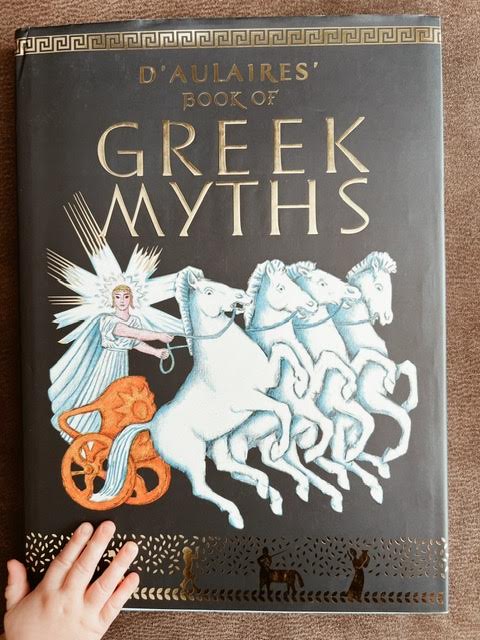
This Memoria Press course is basically an add-on to the classic book D’Aulaires’ Book of Greek Myths which was originally published in 1962. After a lot of research and many trips to Greece, it was written and illustrated by artists Ingri and Edgar Parin d’Aulaire. It tells the story of Greek mythology from the time of Gaea (Mother Earth) and Uranus (Father Sky) begetting the Titans to the Trojan War and wraps up with the Romans renaming the Greek gods. The D’Aulaires’ book is known for its readability and beautiful lithograph illustrations. It’s one of those classics that is worth having in your home library even if you don’t use this curriculum. It makes a great read-aloud all on its own.
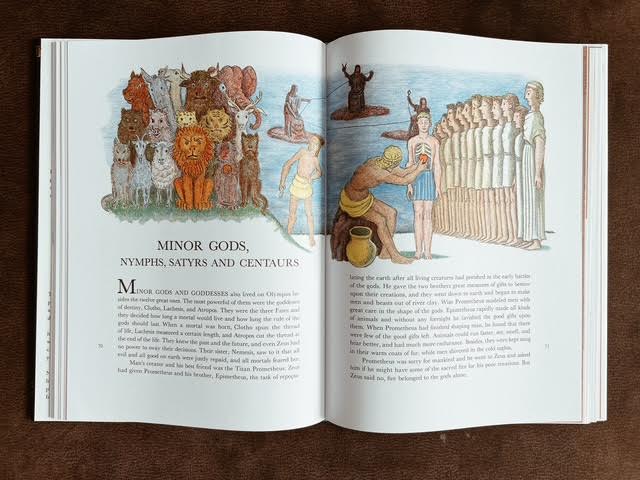
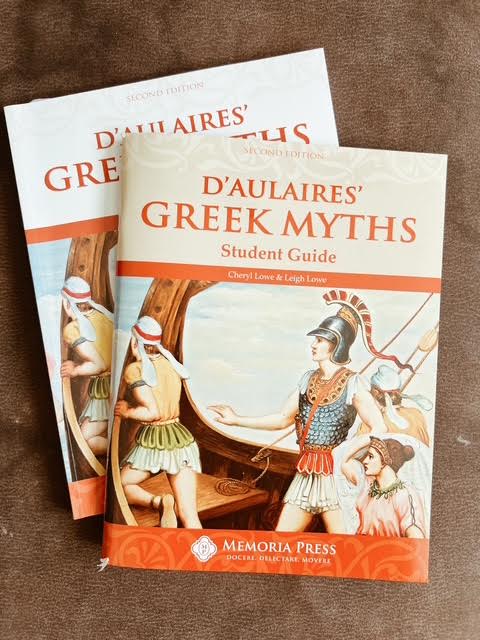
You can order this beautiful edition from Memoria Press or, if you already own the book and want your student to really master the material, you can just buy the teacher manual and student workbook.
The Memoria Press curriculum that accompanies the book is meant to last an entire school year and divides the D’Aulaires’ work into 25 reading passages accompanied by a full lesson for each and 5 review lessons on top of that.
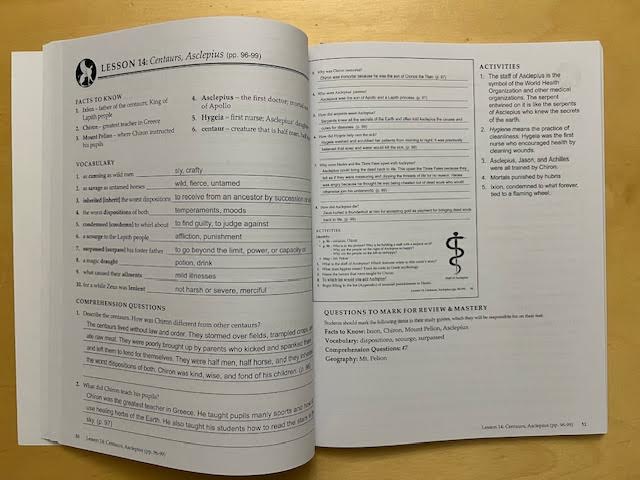
Lesson Format
Each lesson has approximately 5 – 7 reading pages from the D’Aulaires’ Book of Greek Myths. In the student textbook, there are about 10 facts to know from each of the readings, followed by 10 vocabulary words lifted directly from the pages. Then there are short-answer style comprehension questions. My 6-year-old doesn’t always include the level of detail included in the teacher’s manual, but the process of talking about the answers and making an effort to put even the simplest answer in her own words has done wonders for her ability to recall the stories and the characters.
Evaluation
After every five lessons, there is a review lesson and then a test. The tests are quite comprehensive and include not only the vocabulary words but geography as well. The final exam is cumulative. And no, the questions are not all multiple choice. If you want to come away from this coursing actually knowing Greek mythology, then you won’t be disappointed.
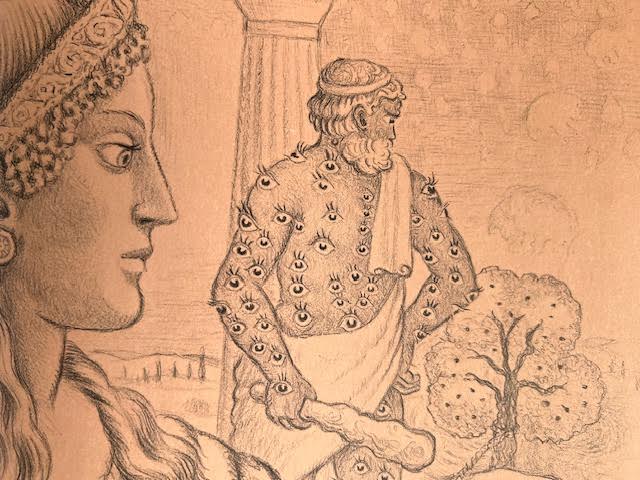
How We Use Memoria Press Greek Myths in 3rd Grade
Both my 6-year-old 3rd grader and my 3-year-old love listening to the Greek myths. Monday is the day we do the reading from D’Aulaires’ and they both enjoy it and ask lots of questions. Especially the 3-year-old. Lots of interesting questions. Sure, some of the stories are scandalous. But if you’re used to reading the Bible to your kids, it’s nothing you can’t handle. On Tuesday, my daughter and I review the story. She tells me what she remembers and I fill in any gaps. We then define the vocabulary words together. On Wednesday, we work through the comprehension questions together. Thursday, we go over any map work and fill out the drill questions in the back of her book. On Friday, I quiz her on her flashcards.
Every week, I make flashcards for the important facts to know and vocabulary (marked in the teacher manual as what will be tested on later). These flashcards get reviewed whenever my daughter is left to her own devices and needs to be working on something. When she’s older and writing isn’t such a heavy lift for her, she’ll be making her own flashcards. For now, it’s more time efficient for me to make them. They’re a great way to study for tests, have independent work for her when I get called away during lesson time and make it easy to drill the important stuff on Fridays. This class literally takes minutes a day and some weeks, it’s only a 4-day class for us.
TLDR: Pros vs Cons
To sum up this Memoria Press Greek Myths review, here are the pros and cons of buying this curriculum to study D’Aulaires’ Book of Greek Myths and master Greek mythology:
PROS
- Mastery is the objective. You aren’t just reading these Greek myths. You’re learning them.
- Focus on vocabulary. Instead of just defining the words that would be tricky for a third grader, there is an emphasis on actually learning these words.
- Predictable Lesson Format. Like all of the other Memoria Press curriculum I have used, the teacher manual follows a predictable format. Once you get it, you get it. You don’t have to waste a lot of time preparing for lessons.
CONS
- Unnecessary? Because every bit of material for this curriculum is taken from the D’Aulaires book, one could argue that the Memoria Press teacher manual and student workbook are unnecessary. That you could get the same education from just buying and reading the one book. In theory, that is true. If you feel you have the time and energy to do that, more power to you!
- Light on activities. If you’re looking for a crafty, hands-on project-based course, this isn’t for you. Their idea of an “activity” is to look up a word in the dictionary.
Who would benefit from Memoria Press Greek Myths?
- The classical teacher who wants to not just read about Greek mythology, but actually master the material.
- The student and teacher who enjoy read-aloud time together.
- The student who loves fairytales and myths.
- The teacher who either doesn’t care about project-based learning or is comfortable supplementing herself.
Have you used this homeschool Greek mythology curriculum? Anything you would add to this Memoria Press Greek Myths review? What about supplemental books and materials for fun?
Keep Reading About…
What classical education is and what classical education is not.
Other Memoria Press curriculum reviews: First Start French I
Join me over on Substack, for a monthly letter from our homeschool — a cozy peek into what we’re reading, studying, and learning along the way.


Leave a Reply