This semester, autumn 2025, I have a 3rd grader, a preschooler and a 9-month-old. My middle child turned 3 this past summer, and is just starting real school work in the sense that we prioritise his schooling every day. In this post I’m sharing the homeschool preschool routine that’s working for us as we make daily progress in his studies.
Preschool Subjects for My 3-year-old Middle Child
- Bible Memory Verses
- Arithmetic
- Phonics
- Music and Cello Practice
- French
- Other Practical Life Skills
Bible Memory Verses
This year my preschooler started AWANA Cubbies. It’s basically an international Bible club that prioritises Bible memory work. As a Cubbie, he is starting to memorise short Bible verses. He listens when I do theology with my 3rd grader, so he’s getting consistent exposure to Bible stories and will ask great questions. But memorising verses for Cubbies is a small responsibility that is his alone.
Arithmetic
I went into detail about how we use the Montessori Method for preschool arithmetic and phonics, but right now, for first semester of preschool, my son is focusing on understanding the digits 0 through 10 and being able to put them in order. Some ways we reinforce this is by playing the card game War. I got this idea from one of my daughter’s Singapore math textbooks and my son absolutely loves this. He’s learning to compare numbers and comprehend “greater than” and “less than”. Sometimes I even use cards so that he can get comfortable with these math symbols.
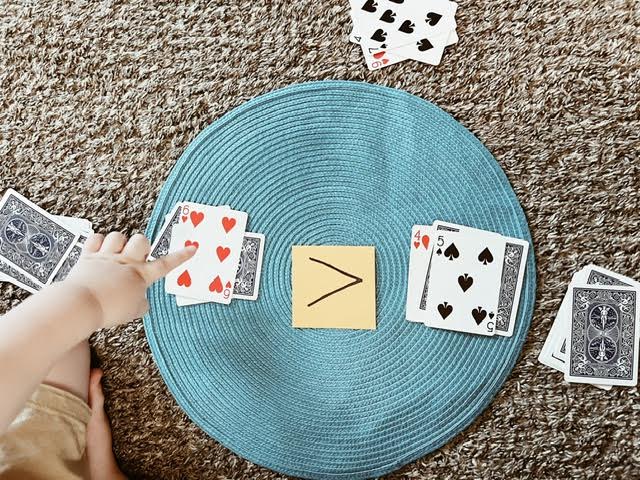
The main reason I prefer to use the Montessori approach for preschool is because of the way Montessori divorces handwriting from the main concepts. For example, if you look at most preschool workbooks in your local bookstore, you’ll see they have the student tracing and trying to write the digits as they introduce the concept of quantity. A workbook page will have the student colour in two of some animal and then trace the number two before going on to teaching three. A young child’s brain can process information so much faster than their little hands can learn to write. My 3-year-old can count up to 20, put the numbers in order, compare those numbers and tell me which is bigger. And yet, his handwritten number two looks like an inchworm. I don’t ignore handwriting and we are actively working on tracing and writing numbers. However, I don’t hold back on teaching arithmetic because his handwriting skills are not on the same level as his comprehension skills.

Current Arithmetic Routine
I will hand my son the mixed up stack of flashcards for the digits 0 through 10 and his job is to lay them on the carpet in order from smallest to largest. Once the numbers are in order, he counts out number blocks for each corresponding number card and places them neatly below each card. Some days we’ll just use the Monetessori number rods for this.
Now it’s time to get out the cards. I take the face cards out of the deck so we’re only working with aces through tens. To play War, you deal the entire deck out to two people. Leave the cards upside down and for a round, each player flips over their top card. The player with the largest number gets to keep both cards. When both cards are the same number, it’s called “War”. On top of the cards already flipped over, each player places two (or three) cards face down. Finally, flip over the next card. Now, the person with the highest number card takes both stacks. The object of the game is to have the largest collection of cards. My 3-year-old loves this. And when some comparisons are tricky, we’ll grab the number blocks for the given numbers and compare to see which quantity is literally bigger.
Phonics
This semester we are finishing up learning the alphabet. We started on this early because my son likes to “do school” when his big sister does school work. Again, I go into more detail about the Montessori approach to phonics instruction in another blog post. But our daily routine right now is to work through the sandpaper alphabet flashcards he has learned. I will hold up a letter, he will say the sound and then trace the letter. While he is tracing, we take turns saying words that start with that sound. When he has mastered those letters – can accurately reproduce the sound the letter makes without confusion or hesitation – I will introduce the next set of letters. We go through the traditional Montessori three-period lesson format for the letters. With this method, we spend quite a bit of time associating the letters with the correct sounds before I actually ask him to recall the sound on his own.
Working through the alphabet cards can take all of five minutes some days. And tracing the sandpaper letters is helping his brain and his hand to learn the proper formation of these symbols. Writing will come later. Some days, just to mix it up, we will play the “eraser game”. I will write some letters he has learned on the whiteboard and his job is to trace the letter to erase it. That’s the great thing about preschool, all you have to do is call something a game and school is fun.

Music and Cello Practice
If you’ve read any other posts on this blog, you’ll know our family really prioritises music education. So my son started cello lessons at the beginning of this semester. We started with a diy cardboard cello – per Suzuki tradition – and finally got a real instrument a few weeks ago. Music practice is now officially a part of his daily homeschool preschool routine.
Starting the music journey with a second child who, unsurprisingly, has his own personality and talents has been a huge learning opportunity for me. I’ve come to realise just how different he is from his older sister. I’m glad that I learned more about what made my firstborn the way she is and you can read about our experience learning about and handling Einstein Syndrome. But my son definitely does not have this syndrome. In fact, if anything, he is quite verbally precocious. However awesome these differences are, it does mean a different approach to music practice. And different expectations.
At this age, it takes longer to unpack the cello and set it up than it does to practice the exercises assigned by the teacher. That being said, each repetition of these exercises, each correction of posture, bow hold, etc is helping my son pay attention to details, learn how to control his body, practice following directions, and improve his fine motor skills.

In addition to practicing the cello, we are also learning about rhythm. I haven’t had to buy any books for him yet. I simply draw different types of notes on index cards and we take turns mixing them up and clapping out the rhythms. This is one of those exercises that you could easy incorporate into your own homeschool preschool routine even if you don’t yet have the budget for an instrument. Rhythm and note reading are foundational skills.
About Choosing an Instrument for a Second Child…
A final note about starting a second child on his or her own musical instrument journey: I highly recommend choosing a different instrument than your firstborn, if you can. There are so many benefits, the main one being that mom doesn’t have to worry so much about the comparison issue. Sure, I can see differences between my daughter and my son, but at the end of the day, it’s not a true comparison because they are learning different instruments. Each child is free to learn at his or her own pace and have their own unique experience. This is one decision I believe I got right and would recommend.
French
Just like with my oldest child, I’m starting French early with my son. I’m constantly rotating in French storybooks into our read-aloud time. I also take vocabulary that he is extremely comfortable with in English and start teaching it in French. For example, colours and shapes. When he’s drawing, I’ll point to colours in his work and say the name of the colour in French. We also use Magna-Tiles and blocks to practice using the French word in place of the English. This doesn’t take any prep on my part and is super easy to add into our homeschool preschool routine. I simply pick a theme and swap out the language until he gets used to it. Then we move onto more words.
Other Life Skills
These subjects are the core skills – the non-negotiables for every school day. But depending on the day and the mood my son is in, we incorporate other learning activities into the homeschool preschool routine:
- cutting straight lines with scissors
- making simple crafts that require glue
- helping prepare lunch
- setting the table
- helping unload the dishwasher
- sorting laundry
- folding washcloths
When We Fit It In
Third grade is quite an intense grade for a classically educated student. It’s a heavy work load and requires a lot of teacher direction. And as everyone knows, babies are their own bundle of demanding joy. So in order to consistently work on each preschool subject, we maintain a flexible homeschool preschool routine so that we can take advantage of baby naps. So far my youngest naps twice a day this semester.
Once my daughter is down for her first nap, I make sure my third grader is set up with a list of independent work. (This is organised ahead of time and made when I make her weekly schedule.) I then turn my focus on my preschooler. It depends on my son’s mood and energy level, but I try to do cello practice with him first. It is the most demanding for both of us, so I like to get it done right away so that even if my daughter wakes up early, we have it done.
Tips for Your Homeschool Preschool Routine
The reason this works – the reason we can do all of preschool during nap time – is because we don’t spend a lot of time on any one subject. It only takes a few minutes of focused attention to make daily progress IF you are consistent. Every weekday, without fail, we hit each of these subjects.
I am the first to admit that I can be intense when it comes to our homeschool. I set very high standards and run a tight ship. That being said, preschool, especially at age 3 is not the time to be overbearing when it comes to schoolwork. I have learned from experience that even just a few minutes a day can yield great results. So I refuse to get stressed about preschool.
The main objective for preschool, I believe, is to start to make school a daily routine. Of course, I want my son to be able to read as soon as he’s ready. But more than that, I want my 3-year-old to get used to the idea that when we wake up, we get ready for the day and then we learn things. Study is a daily habit and a priority for our family, no matter the age.
Tracking Preschool
I have a blog post about how I make my oldest daughter’s school schedule – a very simple weekly schedule with a box for each subject for each day of the week. I print a similar schedule for my son’s preschool subjects, but instead of filling it out, I leave his blank. As we do a subject, I either check the box or write down notes so I have a record of what we worked on and what needs more attention. For example, I’ll check off that he said his memory verse to me or practiced cello, but I’ll write down what letter sounds he needs extra review time with tomorrow. It takes seconds, but exists as proof that we are making progress and I will have a record of what we did for preschool when the year comes to a close.
Keep Reading About…
More details about how we use the Montessori Method for phonics and maths.
Tips for Effective Music Practice at Home
Learn more about how Einstein Syndrome effects musical ability.
How to make a Cardboard Cello for beginner Suzuki students.
How to get started with a foreign language: Introducing a Foreign Language into your Homeschool


Leave a Reply