In my last post about Getting Started, I talked about the different approaches and the importance of writing down your Why for teaching a foreign language in your homeschool. In this post, I’m going to dive into the practical side. The How.
Setting Goals from the Outset for Your Homeschool Foreign Language
It’s important to know where you’re headed, because just memorising lists of vocabulary is not an end in itself (unless you’re just trying to pass Spanish in a public high school). Some examples of long-term goals for your homeschool foreign language could be…
- Being able to speak with a relative who is a native speaker of that language.
- A trip to a location where the language is spoken – and having your kids be able to greet people, read a menu, read street signs, talk to other kids at the playground, etc.
- Being able to read books and watch movies in the language.
- For older students, career goals could be a big part of foreign language learning goals. This could include passing proficiency exams.
Pre-Readers
For Pre-Readers, getting the sound of the language in their ears as soon as possible and hearing a lot of vocabulary is priority number one. Some people think this means they can plop their two-year-old in front of a cartoon in the foreign language and be done with it. Studies have shown that this is actually useless. Young children watching tv in a foreign language do not actually learn anything. The absolute best way to increase your young child’s vocabulary – after speaking the language to them – is reading to your child in the language. (See The Bilingual Edge for more information about this study.)
So if you’re planning your Preschool or Kindergarten year and are going to incorporate a foreign language, I recommend scheduling a listening time and a reading time each day in the foreign language, with particular focus on repetition and active engagement.
Listening Time
This was difficult for me at first. Trying to figure out how to speak more in French during the day with just my daughter around, knowing she wouldn’t understand me. It feels a bit weird. This will look different for different people. Some people like to use the target language at a certain time of day, like meal times. I ended up just sprinkling French in whenever a thought would come to me in French first.
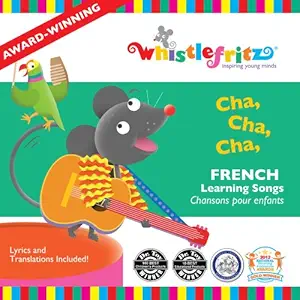
In addition to speaking the language around your child, I also recommend music. Not just any music, but children’s songs that are repetitive, that you can use hand motions for and actually make your child an active participant in the song. Not like passively listening to foreign music in the background (similar to watching tv).
Reading Time
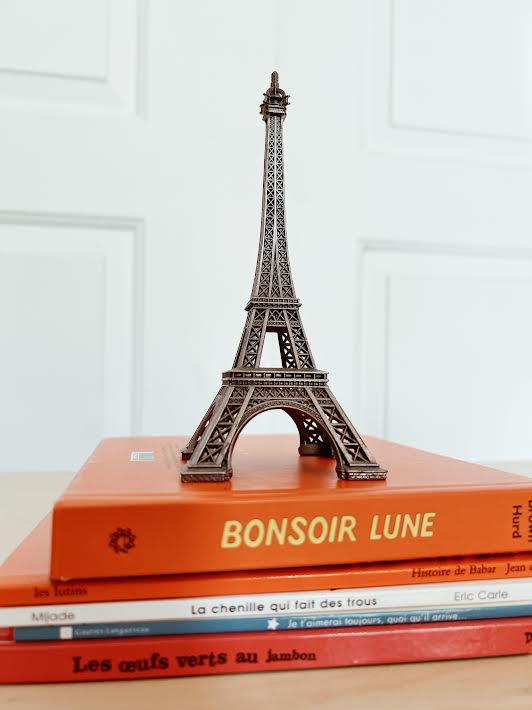
This could be as simple as adding bedtime stories in the foreign language to your routine. Again, try to focus on repetition and making your child an active participant. In some ways, having a tiny library in your target language is a good thing since it will force you to read the same books over and over. And over again. Point to the pictures as you read and ask questions in the foreign language about the illustrations.
Readers
Once your student can read in his/her native language, things get more fun when it comes to teaching a foreign language in your homeschool. There are so many games and activities that you can incorporate now that you couldn’t before. Of course, it will also come with its own challenges.
If you started teaching the target language to your student as a Pre-Reader, you’ll now be reinforcing their understanding by introducing phonics and teaching them to read the words they already understand.
The next step (or the first step if you didn’t start at the Pre-Reader stage) is to start teaching as much vocabulary as you possibly can and focus on the essentials of grammar. For the romance languages, this will be verb conjugation. As I mentioned in my last post, finding age-appropriate and affordable foreign language resources has been a challenge where I live. I have had to make from scratch or tweak most everything I have. For this year, we are using a traditional American-style French textbook with vocabulary lists to learn for each chapter.

I would not recommend a textbook like this as a stand-alone curriculum for any foreign language. For one thing, there is no phonics instruction. There are recordings of the vocabulary lists that come on an accompanying CD. But as far as sounding out new words, you are on your own for introducing and reinforcing the phonemes.
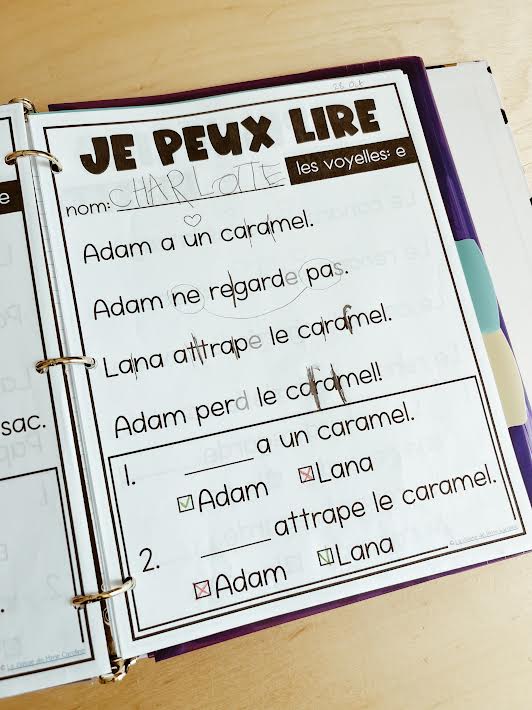
For French in particular, I have had to lean on the resources provided by Canadian teachers on Teachers Pay Teachers. I use beginner-friendly reading worksheets to review pronunciation, practice syllables, introduce common verbs and review how verb conjugation works. If you had to make these from scratch, it wouldn’t be terribly difficult. But it was worth it to me to pay $6 to have worksheets ready-made to print and use.
The point here is to break down a sentence into its parts and only focus on a few phonemes at a time. Think the Bob Books but in the foreign language you’re teaching in your homeschool. This is a good time to review the gender of nouns, the conjugation of a verb with the appropriate pronoun, negatives, etc.
When it comes to teaching vocabulary, I use the vocabulary lists in the textbook as a guide (my second grader doesn’t need to know how to say mother-in-law in French) and then make her flashcards. I like to use Montessori’s Three-Period Lesson approach to teach vocabulary, so my flashcards look like this:

I print and laminate a set that are labeled as well as a second set with the image and label separate. At the beginning of the week we practice pronunciation with the labeled cards, then after a few days, I have her label them. Sometimes Friday is too soon, so depending on the difficulty of the list, by the second week I’ll have her tell me what the object is just by looking at the picture.
Short But Consistent Lessons are Key for Teaching a Foreign Language in Your Homeschool
This might be starting to sound like a lot of work and a lot of time. But if you read my post about how to make a weekly homeschool schedule, you’ll know I ascribe to the idea that daily, short lessons are the best approach. We spend literally minutes a day on French. We review vocabulary, going over why the words are pronounced the way they are and we do a reading worksheet. Some days we focus on verb conjugations, other days we focus on reviewing old vocabulary. There is no way to do everything everyday. But when you consistently work on the language every day, I promise you’ll see progress.
Don’t Forget Yourself!
One of the things I wish I had paid more attention to at the beginning of this journey with my daughter was keeping my own metaphorical French cup full. Even if you feel 100% confident in the language you are teaching (which I wasn’t) it is still immensely helpful to take time to focus on your own language skills. Being able to speak and understand a foreign language is a skill that will atrophy over time if it is not exercised.
Even though I have moved on and am studying other languages at the moment, I try to keep my French up to par by continuing to read in the language and watch movies in the language when I can. Setting personal goals for yourself, apart from your student(s), is a great way to keep yourself as the teacher motivated and excited about the foreign language you are teaching in your homeschool.
Resources for French Specifically
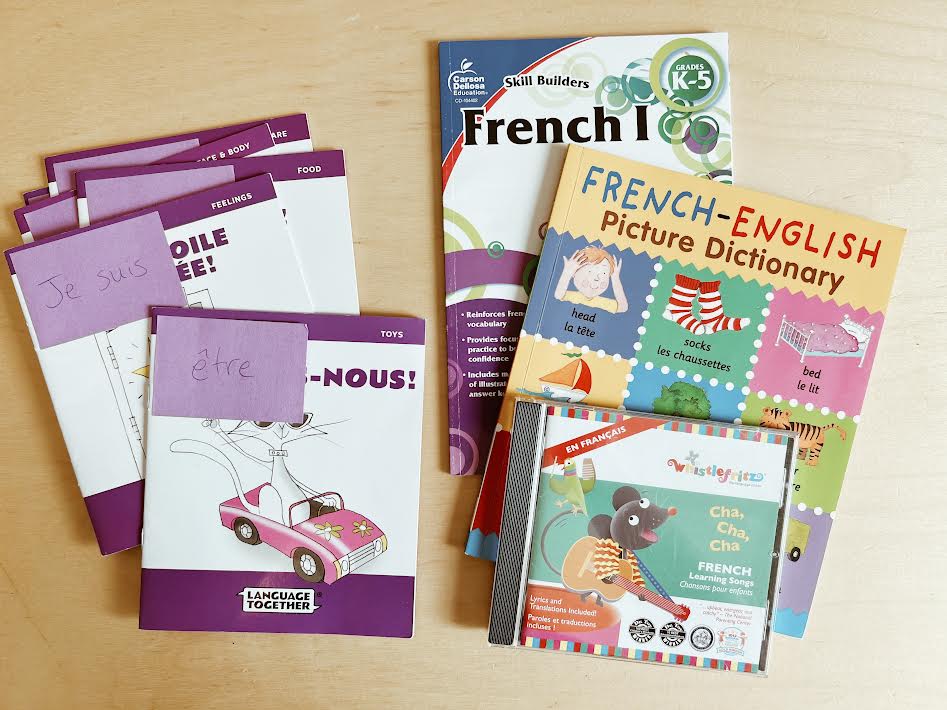
If you’re interested in the French resources I mentioned, here are the links:
- Whistlefritz Cha, Cha, Cha French Learning Songs CD
- Language Together books: Set 1 and Set 2
- French-English Picture Dictionary
- My favourite Teachers Pay Teachers shop & the Je Peux Lire worksheets
- Memoria Press’s First Start French
Keep Reading About…
Review of First Start French I from Memoria Press
20 French Club Activities for your homeschool
Getting Started with a Foreign Language in your homeschool


Leave a Reply