Have you ever made your homeschool schedule for the day, listed all the subjects you’re going to work on, their lesson numbers, and then realised that getting that math lesson or that reading assignment done took your entire morning? You’re now trying to scramble to get all the other subjects finished before the school day is done. (If you even have a cut-off time for your school day.) Fast forward to Friday and your week’s schedule is a mess. Maybe you did get math done every day, but that foreign language never happened, only 4 out of 5 of the English assignments got done and you maybe taught science 2 days this week… sound familiar?
This was one of my biggest regrets when I first started homeschooling my oldest. A few weeks of this and I swore never again. I switched to time blocking and never looked back.

What is time blocking?
Time blocking means deciding how much time you’re going to spend on a subject rather than how much work you’re going to finish.
Instead of putting “Math Lesson 35” on your schedule and working on it until it’s finished, you might schedule an hour for math. When that hour is over, you move on to the next subject—even if you haven’t finished the lesson.
This is actually how traditional schools work, too. A school might have a 45-minute math period, followed by a 45-minute English period, followed by science. The teacher doesn’t keep the entire class in math until every student has completed the day’s assignment.
The difference is that your homeschool day probably doesn’t look like a traditional school day.
You might be using two or three different curricula, adding foreign language or music, working with multiple children, or simply trying to accomplish more subjects than a typical school schedule allows. And the person who wrote your math curriculum doesn’t know how long your child takes to complete a lesson—or what else you’re trying to fit into your day.
That’s why I prefer to time block our homeschool schedule.
I’m not planning my day around how much work a curriculum writer thinks we should accomplish. I’m deciding how much time we have available for each subject and making sure that the subjects that matter actually get that time.
Advantages to Time Blocking
One of the key advantages to time blocking for me is being able to get the “extras” done. Those subjects like foreign languages, music theory, typing, or even science. I know for some homeschoolers, math and English dominate the entire schedule to the point that science and history are considered extra in the elementary years. Are math and English core subjects? Absolutely. But that doesn’t mean you can’t and shouldn’t study other important academic subjects. Time blocking your school schedule ensures every subject that you want to get done actually gets done.
Another reason that time blocking is a brilliant way to approach your homeschool schedule is that it enforces consistency. I could go on and on about consistency, but I will restrain myself. In short, it’s better to be consistent in your studies, even if it’s just a few minutes daily, than to spend several hours on a subject and then to go days without looking at it again. There have been studies. It’s a thing. Time blocking forces you to be consistent in everything you have allotted time for, even if you really want to “just finish this lesson”.
Finally, one of the reasons time blocking is great for the students themselves is that it teaches them to work quickly and efficiently. I know for my daughter that having a timer for math is a huge motivator. She knows math will have an end time – she never has to worry about it stretching to fill an entire morning if she’s stuck on something. And it gives her a sense of urgency. Especially if she knows that if she doesn’t get her assignment done (not necessarily a “lesson” per the curriculum), then she will have homework. More on “homework” below.
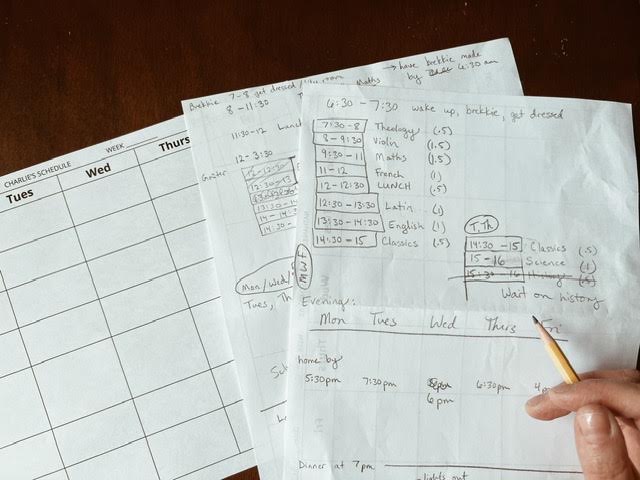
What happens when the block ends and the lesson isn’t done?
If the timer goes off and your student is only halfway through the assignment for that day, there are usually only two possible reasons. Both can and should be fixed as soon as possible.
Problem #1 Too Much Work
This is super common the first week of school, especially if you have new subjects. If you’re like me, you’re ambitious and think you can get so much more done than you realistically can. You schedule a ton of work, assuming your child is always running on peak attention, high energy, and, frankly, non-human levels of focus. This is just a friendly reminder that, yes, your child is human. Don’t over-schedule those time blocks. You can be ambitious AND realistic.
Problem #2 Poor Time Management
If it’s at least a few weeks into the school year and you know you have a good feel for how long it takes your student to get a certain work load done but it’s not getting done lately, you might have this issue. Observe. Is your child distracted? Tired? Playing around instead of doing his work? Pay attention to what’s actually going on. You can’t address the problem until you’ve identified it.
Homework Philosophy
I talked about homework in my post about how to plan your homeschool year. Personally, I define homework as any school work that was scheduled for that day, didn’t get done in the time block, and must be done that day. I purposely schedule lighter days so that I can easily move work to another day in the week without throwing my weekly schedule off. For example, Fridays are usually always light school days when I make the schedule. If something gets behind during the week, we can usually make it up on Friday.
However, occasionally, an assignment needs to be done on a specific day because of an upcoming test or project. That’s when my daughter will be given homework. I try to avoid this at all costs and have worked hard to make sure I don’t over-schedule her time blocks. However, she is just a kid and is learning to be a good steward of her time. So she still will goof off sometimes and waste her time blocks. That’s when I assign homework. If we are home and it’s a choice between her having free time to watch tv or play, but her assignment wasn’t finished during school hours, well, she knows she has homework to finish first.
Please notice how flexible that is. There is a constant balance between outside commitments to things like orchestra rehearsals or dance classes and academic work. To me, both are important. So the decision to assign homework is on a case-by-case basis depending entirely on circumstances. I just want to throw that out there – remember that even if you are running a rigorous homeschool, you are in charge and get to make these decisions.
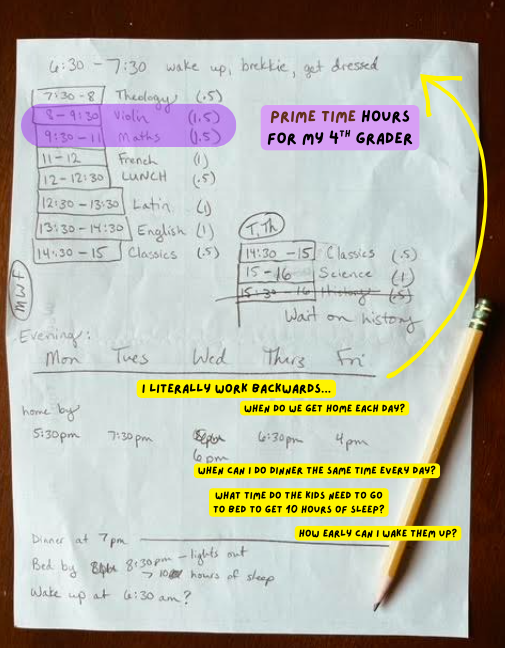
How to Create a Time-Blocked Homeschool Schedule
This is where your planning plays a critical role. I go into my school planning session already knowing how many hours in the day I have for school. Because I have part-time work and juggle the kids’ extracurricular activities, I have to treat homeschool like a regular job. That means a set start time and end time. Between the start and end time, I sketch out half-hour blocks and a lunch break. I decide how long the core subjects (these are the ones that get prime-time morning focus hours) will take based on reading the teacher manuals and then slot in the “extras” with the rest of the time.
Some subjects lend themselves well to alternating, like science on Monday, Wednesday, Friday and history on Tuesday and Thursday. Other subjects really do need that daily consistency. So Latin and French I make sure to put on the schedule every day, even if the time is short. For us, that has meant that our French curriculum is taking longer to get through than the publisher suggested and that’s ok. Those are the decisions I get to make as the homeschool teacher.
Conclusion
Time blocking is one of those skills that I have borrowed from past teaching experience and business experience and successfully applied to my homeschool. No, it won’t work for everyone. Especially those concerned about homeschool looking too much like public school. I just want to share what helps a super ambitious working mom cover two foreign languages, advanced mathematics, and rigorous music education in our homeschool.
Keep Reading About…
How to plan a homeschool year: my step-by-step process or the how-to of planning a homeschool year
Print out my blank weekly schedules and see how I plan a week
Tips for balancing extracurriculars with a rigorous academic load
More productivity tips (besides time blocking)


Leave a Reply