It’s that time of the year – all the curriculum I ordered is here and I need to prepare for the next school year so it’s ready to go come September. I actually love this part of homeschooling so much. I geek out about all things academia and organisation, so this is truly my happy place. Depending on how the summer is going, I usually start this process about a month or two before school starts so I have time to do everything on this list. My goal is simple: by the first day of school, I want every major decision already made so I can spend my time teaching instead of scrambling to get organised. If you want my streamlined routine for preparing a new homeschool year, here is my complete process.
The Preparation Process
- Step 1: Plan the Year (i.e., know where you’re going)
- Step 2: Print Blank Weekly Schedules
- Step 3: Read the Teacher Manuals
- Step 4: Make Your First Week of School Schedule
- Step 5: Print Daily Assignment Sheets (and make Monday’s)
- Step 6: Organize Your Teacher Binder
- Step 7: Organize Your Physical Space
- Step 8: Prep First-Day-of-School Shenanigans
- Step 9: Order School Uniforms
1. Plan the Year
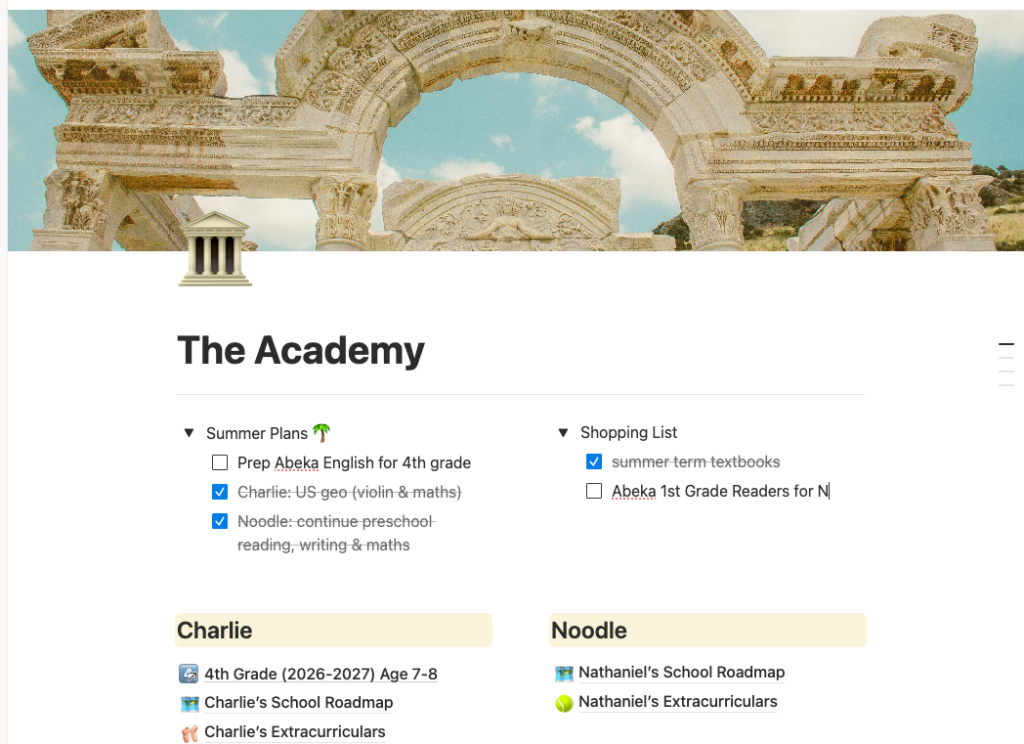
I already wrote an entire blog post about how I plan ahead and keep my thoughts organised in Notion for the scope and sequence of our homeschool. So the rest of this post is assuming you (1) already know which weeks are in your school year, have start and end dates, breaks, etc. marked on your calendar, and (2) already have chosen and ordered your curriculum based on the previous school year and possibly summer school.
2. Print Blank Weekly Schedules
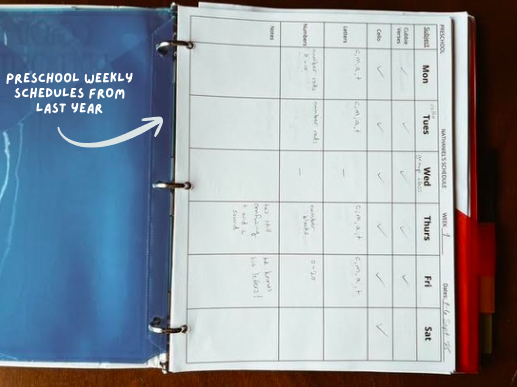
Once I know my school year and have it marked on the calendar, I will print out all of my weekly schedules based on the number of weeks we are doing school. The weekly schedules are numbered based on which week of school they are for and include the dates. I have one set for my daughter and one for my son. I personalise these in Canva for our subjects, but I made a blank version that you can print for yourself. Check out this post on how I plan a school week. Basically, once I know our extracurricular schedule and have read the teacher manuals (see next step), then I fill in the first week of school.
Going forward, I use Fridays to make the following week’s schedule. This is just one micro habit that keeps my homeschool running smoothly. It takes minutes to do because it is mostly a copy/paste of the week we just finished. But by doing it on Friday, I can adjust for unforeseen circumstances (like sick kids), know when tests are coming up, plan a light day for when that doctor appointment is scheduled, etc.
3. Read the Teacher Manuals
Why read through the teacher manuals? In case it’s not obvious, let me make a case for why reading the teacher manuals now is going to make your life so much easier. If you read through the teacher manuals before school starts:
- You know how many days per week need to be allotted to that class.
- You can have a reasonably good assessment of how long that class will take.
- You can prepare the materials (science experiments!) and/or books required to teach the class.
- You can mark your calendar or set reminders for when library books need to be requested for a research paper or when any other project will require special attention.
- You can have any worksheets or other printables actually printed and ready-to-go for your school binder, at least for the first few weeks. (I don’t like to get too far ahead with this.)
- You can make your own worksheets if you foresee your student needing extra practice in a certain area.
Knowing this information will help you make a realistic first-week-of-school schedule. And the more realistic you can make that first week’s schedule, the more encouraging the results will be – you can start the school year off with the right momentum. Otherwise, if you bog down the schedule with too much work and not enough time to get it all done, you’re going to end up with discouraged students who already have homework their first week of school.
I will also mention that the more you stick to a set curriculum, the easier and faster this step becomes every year. For example, by using Memoria Press for so many school subjects – besides the high quality material – I have the advantage of already knowing how they organise their lessons, how much time a lesson takes, and that I usually need to make a few extra worksheets for some of their classes. Same idea goes with using Abeka consistently for English. I know what’s expected and I can easily skim lesson plans and jot down my weekly schedule.
4. Make Your First Week of School Schedule
You know your extracurricular activities so you know which days will be intense and which will be more laid-back. You know Wednesday mornings are going to be sluggish because orchestra rehearsals run late on Tuesday nights. You’ve read your teacher manuals so you know how demanding each subject is and what can realistically get accomplished in the time you have allotted for each subject. Now, write out your schedule for the first week of school for each kid. I actually do this while I’m reading a teacher manual. For example, skim teacher manual for Latin, write out first week’s schedule. Skim teacher manual for English grammar, write out first week’s schedule.
I highly, highly recommend using time blocks. This means, if you have an hour and a half scheduled for math, it doesn’t matter if your kid is not done with his lesson in that allotted time. It’s time to move on. This keeps the day moving and ensures each class is done each day. You can decide how to handle work that is not finished. For some subjects, like math, I am not concerned about a lesson getting completed. I’m more concerned about the daily consistency and know that we will get ahead every summer regardless. But for other subjects, unfinished work can be homework that night, or something that is eventually pushed to Saturday. Yes, even though we have a lot of extracurriculars (including Saturday morning taekwondo classes), homework is expected to get done. Otherwise it will throw off next week’s schedule.
If you notice that unfinished work becomes a trend, take time to figure out what’s going on. Sometimes it’s an issue of a student not being diligent and getting easily sidetracked. However, it could also be a planning problem. It might just mean you’re scheduling too much work for the time your student has. Be honest with yourself and your student about what’s happening. Nobody likes having homework always hanging over their head.
5. Print Daily Assignment Sheets
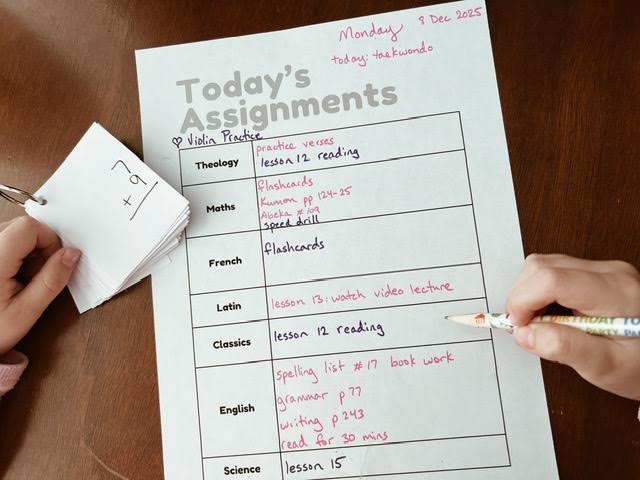
I will print out several of these daily assignment sheets for my daughter and fill in the first day of school only. My son just has a list of his subjects, so he knows what needs to be done before school is finished for the day. But my daughter is old enough to read an assignment sheet for herself and work independently, for the most part. I’m constantly checking in with her, but this way she has an assignment sheet of her own that shows her just what needs to be accomplished for the day. And how much time she has for each subject. When it is finished, she is done with school. If it’s not finished when the school day is over, she will have homework.
I use two different coloured pens so she knows when to get me and what she is expected to be able to do on her own. These are for her use and we discard them at the end of the day. The weekly schedule is what I look at during the day and throughout the week. I keep them in my teacher binder. (And eventually file them away in her portfolio for that grade at the end of the school year.)
6. Organize Your Teacher Binder
I keep 3-ring binders for a lot of things in my life (research for work, recipes, bills, etc.) and homeschooling is no exception. Having already been through the teacher manuals for my kids’ curriculum, I make sure I have a way to organise any paperwork on my end. For example, I have copies of speed drills ready to go for math and worksheets that I’ve made ahead for French. I have sections for weekly schedules for each of my two kids that are doing school this year. I have sections for subjects that require me to have papers on hand, I have sections for the kids’ extracurriculars that require me to have paperwork (orchestra handouts, ballet rehearsal schedules, music studio rules, etc). If there is a paper related to homeschooling that I am responsible for, it has a place in this binder.
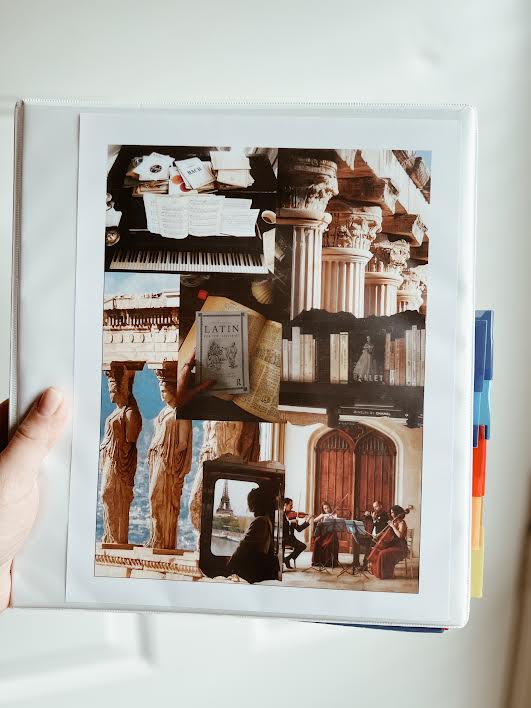
I also use my binder cover to hold a vision board / mood board for the upcoming school year. I use Canva to design a board that fits an 8.5 x 11 inch paper, print it out, and slip it in the front. That way, whenever I get out my school binder, which is daily, Monday through Friday, for the entire school year, I can see my vision board. Everyone’s idea of a vision board will be different, but I choose images that inspire me as a teacher and represent the feeling I want to have when we are at home working on schoolwork. I also use it as a way to lean into and romanticise the subjects I’m not too excited about. Some years it’s more goal-oriented, but this past year was purely aimed at the aesthetic I associated in my head with homeschooling. Be creative!
7. Organize Your Physical Space
Bookshelves, pencil boxes, paper trays, art supplies – now is when I make sure we all have enough pencils, erasers, notebook paper, and printer paper. Old textbooks have been boxed up or stored elsewhere and the new year’s textbooks (and teacher manuals) are where they will be during the school year. Folders or notebooks that are required for various subjects have all been prepped and are sitting snuggly with the textbooks they will accompany. My daughter’s 3-ring binder has already been cleared out when I made her portfolio at the end of last year. Everything has a place and is in its place.
8. Prepare any Special First Day Tradition or Gifts
I do not go crazy for this one. The only thing I do is try to hide some of the cuter school supplies for my kids that I got for school so it can be a surprise on the first day. This can be a compass or colourful ruler for math, a folder with their favourite cartoon characters, fun highlighters, etc. Think stuff they needed for school anyways, but make it more exciting by letting them see all the cool things they’ll use for school on that first Monday morning. I have a list of first-day-of-school ideas in this post about getting back into the homeschool routine after summer.
9. Order School Uniforms
Yes, my kids have uniforms for school. So ordering their uniforms is a part of preparing for the new homeschool year. The kids don’t waste time trying to figure out what to wear, or changing clothes when it’s time to go to a music lesson. We dress for school because studies show that what you wear actually affects how you view yourself. It also helps define school time for us. Yes, I use hourly blocks and we have a set time when school is finished. But when you’re homeschooled (and probably working at the kitchen table ), having a physical reminder of the fact that you are in student mode and should be focusing on the work in front of you is super helpful.
Final Reminders
There are so many things that go into preparing for a homeschool year. Especially if you’re trying to balance outside work. Here are my two non-negotiables: (1) School has set hours. You might be a mother 24/7, but you are not a teacher 24/7. School has a start time and, more importantly, an end time. For your own sanity, avoid at all costs any “homework”. I try very hard to avoid regular homework so that my kids have free time to play or just simply be bored. If homework becomes a pattern, I take it as a sign that I need to adjust our schedule rather than expect them to work longer every afternoon. (2) Before school starts, I eliminate any unnecessary decisions for the school week and, if possible, the entire school year. Personally, that includes meal planning for me and school uniforms for the kids. For you, that could be something else. Whatever it is, the more you can delegate or automate, the better.
Keep Reading About…
Planning out your homeschool year


Leave a Reply