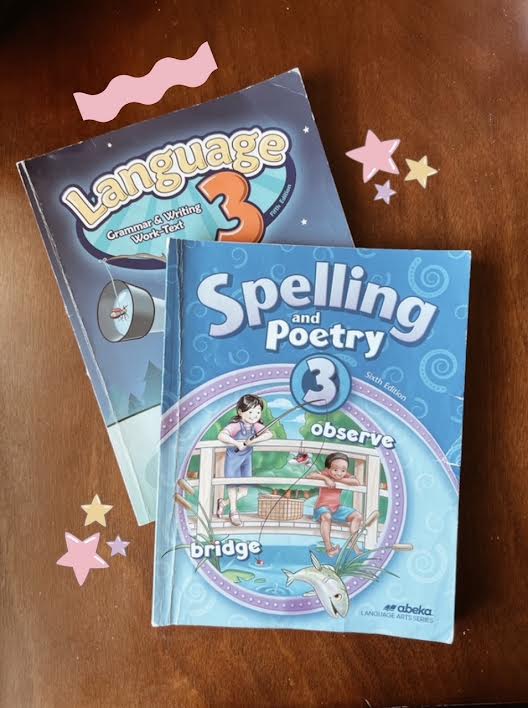
This past year, I used Abeka’s third grade English curriculum with my daughter. I have used Abeka’s English program, for the most part, since kindergarten with her (and now my son). I have not tried any other homeschool curriculum options for English because I already know Abeka – it’s what I grew up with – so I know how to use it and I know it works. Because my daughter was only in third grade, I decided to save some money and skip the teacher’s manuals again this year. I only came to regret that for one particular textbook. If you want the short version of this Abeka 3rd grade English curriculum review, scroll down to the TLDR: Pros vs Cons.
Why Abeka for Homeschool English?
Besides the familiarity on my part, there are several reasons I love using Abeka for English. Abeka uses a spiral approach for all of their curriculum. That means a lot of repetition all year long on the basics. For example, it’s difficult to NOT get into the habit of capitalising the first word of a sentence if you’re practicing it almost every day for an entire school year. Sure, it can seem a bit redundant, but for a student it’s critical to have a solid foundation. I really think Abeka does that well.
Abeka is also known for its very integrated curriculum. The same illustration characters and theme show up throughout the entire grade. If the chapter theme is space, you’ll see those elements in the arithmetic book, the spelling book, the creative writing assignments, etc. Yes, this is fun for kids, but I like it because it means that for English specifically, you get reinforcement of the new concepts on all sides. Practicing using adjectives correctly in Language 3 this week? Your spelling list is probably full of adjectives.
Grammar
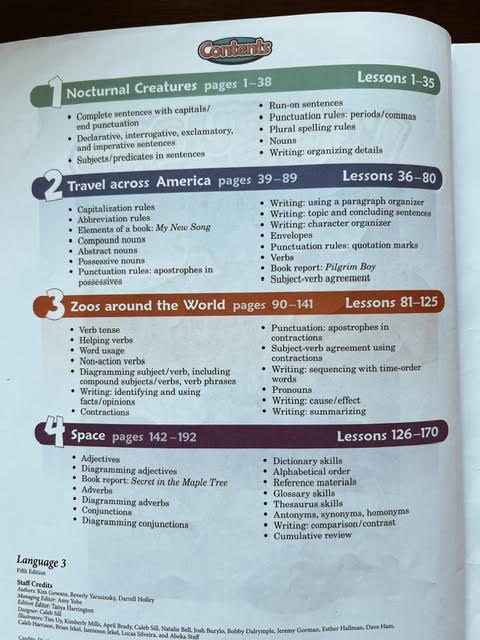
Looking at the Table of Contents, you can see that paragraph organisation is taught at the beginning of the semester and slowly added on to until the student finishing third grade is able to write his own paragraph.
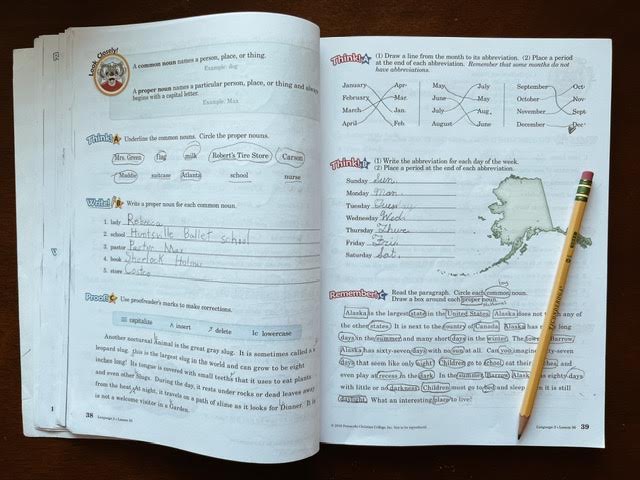
Punctuation is practiced all year long and the parts of speech are focused on throughout as well, as third graders start diagramming sentences. At the end of the school year, students are even taught dictionary skills.
Spelling
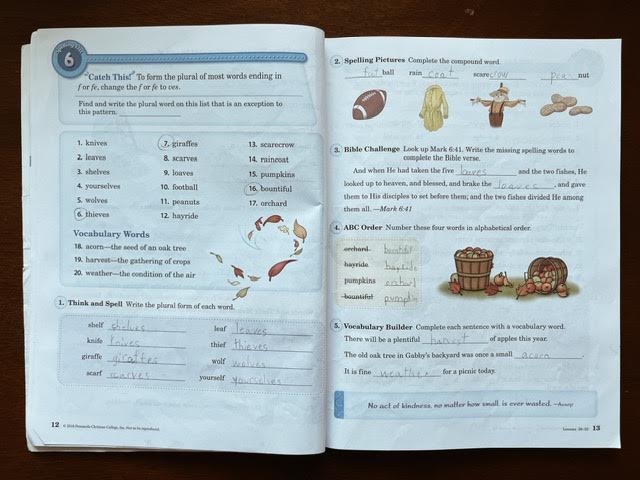
This year, spelling was my daughter’s most difficult part of English. I ended up having to get really creative with practicing the spelling lists. After reviewing the teacher manual for 4th grade English, I can see that Abeka has a lot of great ideas for their classroom teachers to teach the lists, so I wish I had had the teacher manual for 3rd grade – it would have saved some effort on my part.
Cursive & Creative Writing
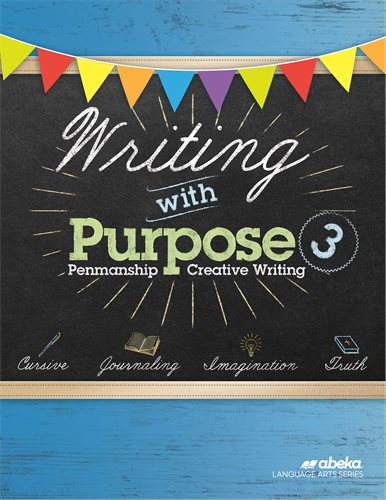
The only part of this curriculum I regretted not having the teacher’s manual for as soon as school started was the Cursive & Creative Writing 3 book. I didn’t notice it immediately because a lot of first semester’s assignments were simple and mainly practicing proper penmanship. However, as the creative writing tasks became more involved, there were several blank pages in the book where I had no idea what the assignment was. Of course, we made it work and I assigned tasks that were relevant, but it wasn’t the level of easy I was used to with Abeka. So yes, I ordered the teacher manual for 4th grade!
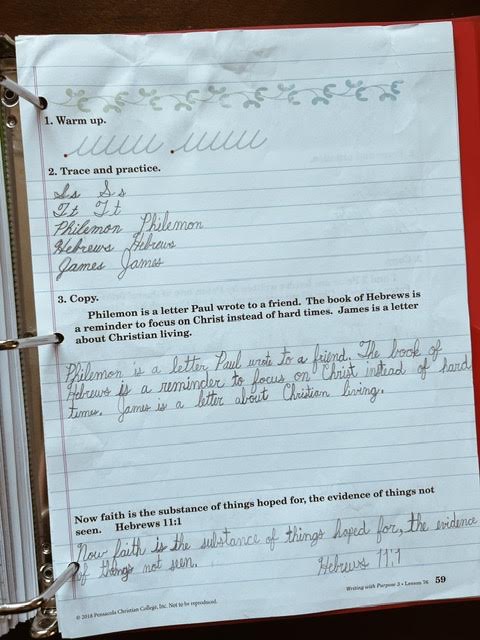
The highlight of this course was paragraph writing. Both the grammar book (Language 3) and Creative Writing 3, scaffolded the forming of a paragraph. They started with identifying topic sentences and concluding sentences in the grammar book, then moved on to having students write their own topic and conclusion for a paragraph body. Later in the creative writing workbook, students were asked to choose topics and make a very simplified outline of a possible paragraph based on reading they had done.
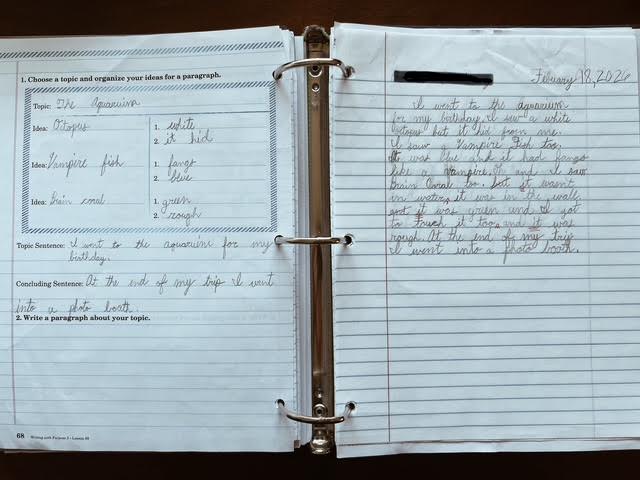
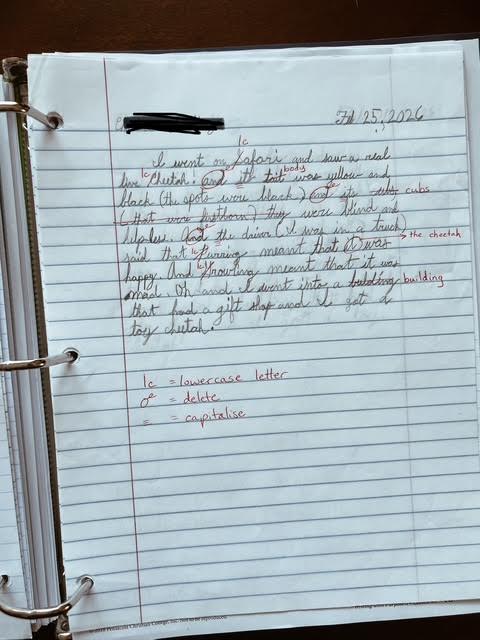
Finally, they were asked to outline and then write a complete paragraph. So yes, by the end of the year, students are able to write full well-structured paragraphs. Even I was surprised to see my 7-year-old daughter’s paragraphs.
Reading
Like last year, I decided to forgo the formal literature study and just required my daughter to read aloud to me. We started with Heidi, and I’m not going to lie, it was quite slow going. At first, I assumed I had chosen a novel that was too difficult, but considering how well she was reading and comprehending the story, I was confused. Once we finished the book and she discovered Matilda, I realized the problem right away. Heidi was just not interesting to her. Despite my asking her several times if she was enjoying the story and her replying in the affirmative, the proof was in the results.
Both Heidi (the modern translation we were reading) and Matilda are generally marketed to the same reading level. However, Heidi was a slog for her and took most of second semester. She finished Matilda in less than a week. Then read Charlie and the Chocolate Factory in less than 24 hours. So lesson learned? Make sure you choose books your children are actually interested in. If you’re interested in what my daughter was able to read the summer after finishing Abeka’s third grade English, you can check out this blog post.
TLDR: Pros vs Cons
For a more concise Abeka 3rd grade English curriculum review, here’s my pro/con list:
PROS
- This program reviews the fundamentals of grammar (parts of speech) and punctuation all year long. Lots of practice.
- The grammar book (Language 3) combined with the Creative Writing 3 assignment book teaches students how to organise, build, and then write paragraphs by the end of the year.
- Lessons are daily (as opposed to Memoria Press, where one lesson is for one week), so it’s very easy to make your weekly school schedule. Each day is already figured out.
- Colourful, fun, age-appropriate illustrations that make all of the Abeka workbooks very child-friendly.
- These lessons are easy to assign as independent work.
CONS
- The Cursive and Creative Writing workbook really needs the teacher manual if you want to get as much out of it as you can. There were many papers in the workbook where I wasn’t sure what the assignment even was. So be prepared to do some extra work and prep if skipping the teacher book.
Who would benefit from Abeka’s 3rd Grade English?
- The busy mother who wants English completely covered: easy-to-assign daily lessons that can be done mostly independently.
- The teacher who wants an integrated grammar, spelling, and creative writing system that reinforces concepts all year long.
- The student who loves colourful workbooks, with lots of cute illustrations.
Keep Reading About…
The rest of our 3rd grade curriculum choices
Abeka curriculum reviews: 2nd Grade English, Arithmetic 3, Abeka Science for 1st and 2nd Grade
What my rising 4th grader read the summer after finishing Abeka’s 3rd Grade English


Leave a Reply