After reading The Einstein Syndrome, I felt compelled to share a bit of my experience homeschooling our gifted child with Einstein Syndrome. Even though she is still young, I’ve had a crash course in what NOT to do when you’re homeschooling your firstborn who turns out to be gifted. I understand some people don’t like to label their kids, but identifying gifted children early can really help you as the homeschool parent manage your expectations and sufficiently challenge your child.
What is Einstein Syndrome?
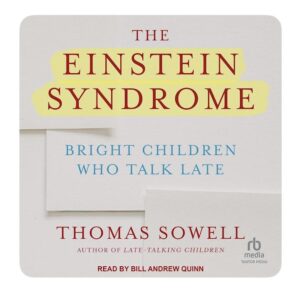
Einstein Syndrome is basically a pretentious name for people who were late talkers as children and have demonstrated outstanding abilities in the “3 Ms”: Memory, Mathematics & Music. There are a small handful of books on the topic, but Thomas Sowell’s The Einstein Syndrome does a great job of defining this group of individuals. Characteristics also include family traits like similar occupations (engineers, musicians, mathematicians, etc) among close relatives as well as some personality and behavioural traits.
In all honesty, I can’t speak to that period when you as the parent are concerned because your young child is not hitting speech milestones and is labeled a “late talker”. Because my daughter was my firstborn and we were in covid lockdown when she was 2, I really had no frame of reference. And by the time I really started to get concerned about her being a late talker and the implications, she soon started saying her first sentences. But if you’re still in that late talking stage and you want to educate yourself on this particular syndrome, then I highly recommend Sowell’s book.
Why Identifying Children with Einstein Syndrome is Helpful
When I first read Thomas Sowell’s book, I had a difficult time trying to figure out what the point was. Why bother with this label? My daughter is talking now. So if I’m not one of those parents trying to decide whether or not to sign my child up for speech therapy, why should I care about a label like “Einstein Syndrome”? Learning that your child falls into this small category of children can help you as the parent:
- Set realistic expectations for your gifted child as well as your other children.
- Realise how useless it is to compare your gifted child’s academic or musical progress with that of her peers.
- Have an idea of what your gifted child’s strengths and passions could be as she gets older.
- Decide how to best educate your gifted child (if you’re on the fence).
Why Homeschool a Gifted Child?
As someone who was homeschooled myself from K-12 and also worked professionally as a teacher in both private and public schools, I had already decided before I was even married that if I had kids, they would be homeschooled. So to be fully transparent, I didn’t have to make this decision when my daughter was starting to show signs that she was an exceptional learner.
But my years of classroom experience taught me that school as an institution does not treat kindly those who are not average. Whether a child’s abilities are lower than average, or much higher, Industrial-Age schooling is not going to benefit the outlier. As a teacher, I experienced first-hand how difficult it was to teach a class of 30+ high schoolers. I “taught” at the average students, gave advanced work to my advanced students to keep them from getting too bored and tried my best to help those who were woefully behind (mainly because teachers aren’t allowed to fail students anymore and make them repeat a grade). Even with the best of intentions, it’s an impossible task.
If you truly want to see your gifted child thrive, I highly recommend investing in them by making the decision to homeschool. Not only will you be able to challenge them at the level they need and want, you’ll also save them the peer pressure to play dumb and stay in the box labeled “average”.
Challenges of Homeschooling a Gifted Child
But lest you think homeschooling your gifted child will be all sunshine and roses, let me set you straight. You’re in for a rude awaking. If you are homeschooling a gifted child, ESPECIALLY if that child is your firstborn, there are definitely some challenges to navigate, like:
- Not having mom friends who can relate and think you’re humble bragging when talking about your challenges.
- Keeping your child academically challenged enough. (Especially if you have a limited budget.)
- Finding an outlet for a seemingly inexhaustible energy supply. (Again, especially if you have a limited budget.)
- Finding appropriate books and projects that are advanced enough to hold their interest and are still age-appropriate.
- Teaching them how to handle failure.
- Teaching them to not be content to compare themselves to their peers, but to always strive to be better than they were yesterday.
- Constantly gear shifting as their parent between their age-appropriate big emotions and their advanced intellectual curiosity.
Tips for Homeschooling Your Gifted Child
I’m still very early in this process, but since homeschooling a gifted child is kind of like living life on fast forward, I feel like the past 6 years have really taught me a lot. Based on my experience, here are my top tips for homeschooling a gifted child, but specifically one with Einstein Syndrome:
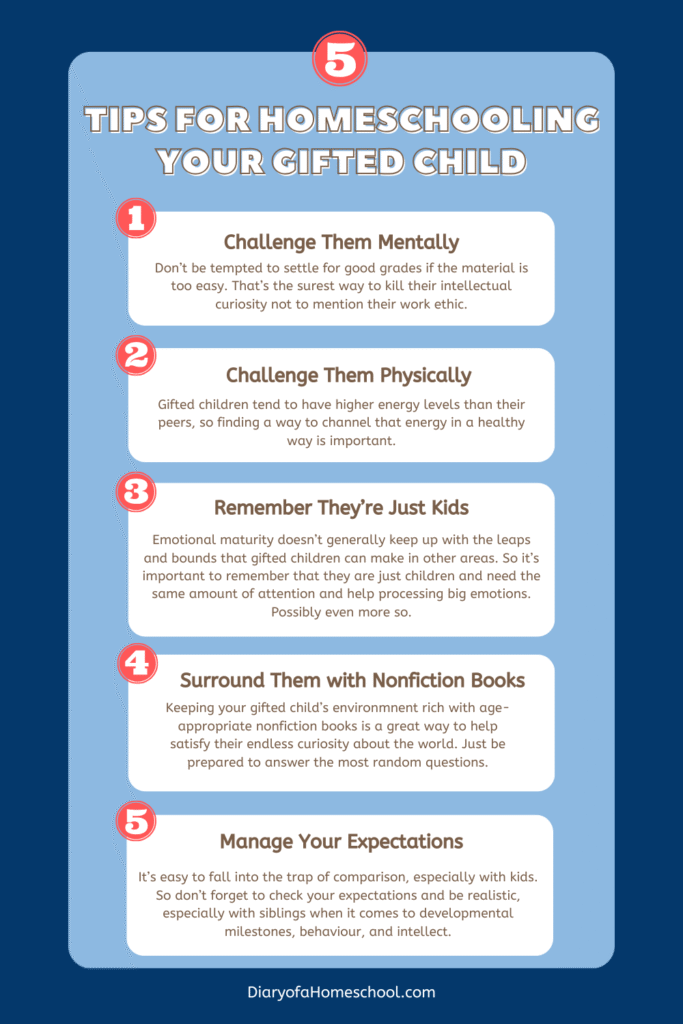
1) Challenge Them Mentally
This is probably obvious, but find things that challenge them mentally. Don’t settle for just getting better grades than their peers. Don’t settle for straight As. Find something that makes them think – that makes their brain have to work. Something they can possibly fail at now, as a child, and learn how to deal with that in a safe space. Where you can make sure they know not everything will always be easy and that’s ok. In my experience, I’ve been able to do this by introducing a lot of topics to my daughter instead of letting her get multiple grade levels ahead in core subjects. English is too easy? Add another language. Or two. Arithmetic is too easy? Start on physics.
2) Challenge Them Physically
Find things that challenge them physically. It wasn’t until I did more research that I found out gifted kids tend to have more “energy” than most. That’s so vague, but it really does describe a kid who has no off switch. If my daughter is getting enough sleep and eating healthy, then she’s regularly up early (goes to her bookshelf as soon as she rolls out of bed) and could easily stay up late doing whatever project she’s working on. In THIS POST I talk about why I’m passionate about extracurriculars and I don’t even mention gifted children. But the more I observe, the more certain I am that athletic extracurricular activities have been incredibly important for my daughter. They challenge her in a way that academic subjects do not and are helping her become a healthy and well-rounded individual.
3) Remember: They’re Just Kids
Don’t forget to treat them like the children they are – in all their silliness and need for attention. Just because your 5-year-old is doing algebra or reading high school chemistry textbooks for fun, she is still just a little kid. This can be so difficult as a parent to process. It means you’re constantly switching gears. One minute you’re answering abstract philosophical questions and the next minute the same kid is asking you to help them put on their pyjamas. And in your head you’re thinking “You can do long division but can’t pull up your pants?”
4) Surround Them with Nonfiction Books
Fill your home with books of all kinds, but especially nonfiction. Most kids love to read or at least be read to. But gifted children tend to really crave nonfiction. I keep baskets full of books all over our home. National Geographic for Kids. Large encyclopaedia-type books on topics ranging from animals to space and human anatomy. When grandparents ask me for gift ideas, I just say books and list the topics my daughter is interested in.
5) Manage Your Expectations
If your firstborn is gifted and you’re not around a lot of children the same age, it can be easy to have a skewed idea of what milestones children should be hitting when. So then when you see your child around their peers, it can be easy to think other kids are “behind”. I’m not saying to lower your standards for what you expect from your other children or even the peers that you allow to be around your gifted child. Just make sure to be realistic about what is actually “normal” for their respective ages.
Final Thoughts on “Giftedness”
Despite Einstein Syndrome being a real, statistically valid label that applies to my daughter, I really do struggle with the idea of “giftedness” and just the definition of “talent” and “potential” overall. If you read Maria Montessori’s work and especially the way she worked with children whom society said had learning disabilities, you might question how we label kids and their learning potential.
I think all children have an astronomical amount of potential that consistently gets wasted because the bar for children and young people in today’s society, especially in the United States, is so incredibly low. Like how kids get points on a state test for writing their names. (I wish I were making this up.) If you treat somebody like he is dumb long enough, he is going to believe it and start acting accordingly. I daresay this is what Maria Montessori proved.
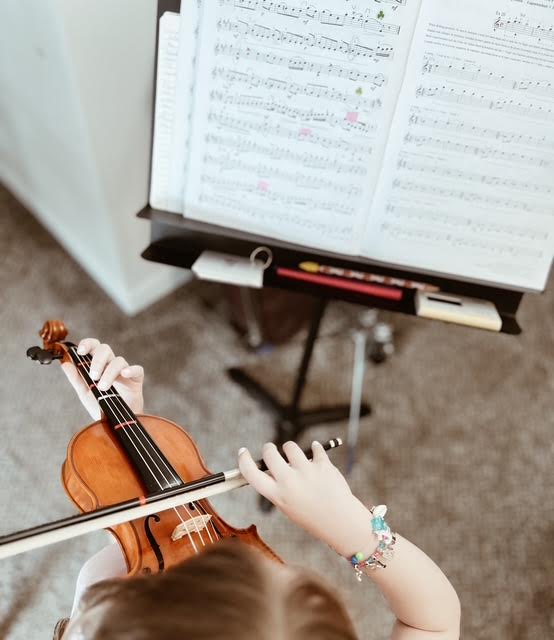
Then there is the idea that “giftedness” is somehow this magic super power that means a child can just do something. But Shinichi Suzuki had a lot to say about this when it came to music. Being gifted as a violinist in no way meant not having to put in the work. So if both gifted and non-gifted violinists have to practice, what’s the difference? Well, I’ve had parents come up to me after a violin recital and comment on how “talented” my daughter is. But then I later find out that their kids don’t practice consistently or for as long as my daughter does.
So, what came first, the chicken or the egg? Is my daughter able to practice longer because it’s not as difficult for her? Or is she simply a better player because she practices more? I’m not really sure there is a right answer here. Just food for thought.
Are you homeschooling a gifted child or considering doing so? Do you have any words of advice to share with fellow parents?
Keep Reading About…
Shinichi Suzuki’s thoughts on natural talent and “giftedness”: read my review of this outstanding Suzuki biography
Classical music in your homeschool through music appreciation or effective practice at home


Leave a Reply