Once a lesson is over, how do you actually help your child remember everything the teacher said? Over these last few years, I’ve developed a simple system that lets my 7-year-old daughter practice much more independently because she always knows exactly what to work on. And how.
1. I Treat Every Lesson Like a Planning Session
During every lesson, my only job is to take detailed notes. I’m not just writing page numbers—I’m recording the teacher’s corrections, demonstrations, practice ideas, and reminders. Those notes become our practice plan for the entire week. Why is this so important?
- The teacher can focus on teaching instead of constantly stopping to write notes.
- I can take notes in a way that makes sense to me when I plan our practice week.
- My daughter doesn’t have to rely on her memory to remember what the teacher wanted.
- Because I was paying close attention, I know exactly what to listen for during practice at home.
Could you record the lesson instead? Sure. But recording is passive. Taking notes forces me to process what the teacher is saying and think about how we’ll practice it at home. I would still end up writing notes afterward, so I’d rather do the thinking once while I’m sitting in the lesson.
2. I Turn Those Notes into a Practice Plan
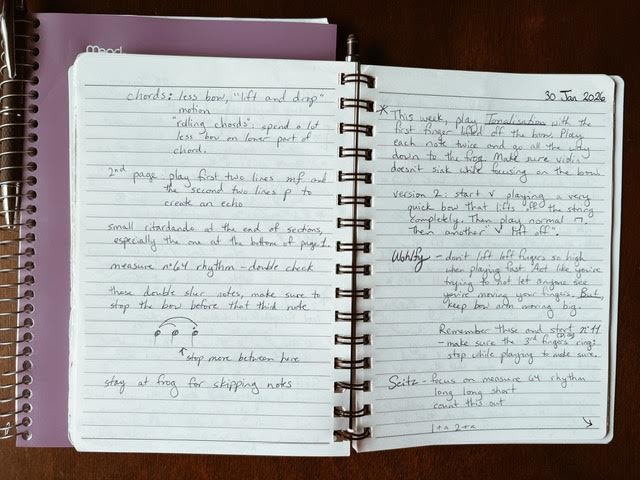
My daughter’s lessons are on Friday afternoons. Later that evening, I take out my laptop and start going through my notes. I used to write these notes for her by hand (you can see a picture of that in this old post), but in order to save time, I now type them up. This saves a lot of time because I can simply edit the previous week’s practice session. There will be weeks when an étude book hasn’t been covered in a lesson so the page numbers and point of focus remains the same. And thanks to Canva, I can drag and drop images that remind her of allusions her teacher made during the lesson (“imagine your arm like a pendulum”). I can also add funny and encouraging little one-liners.
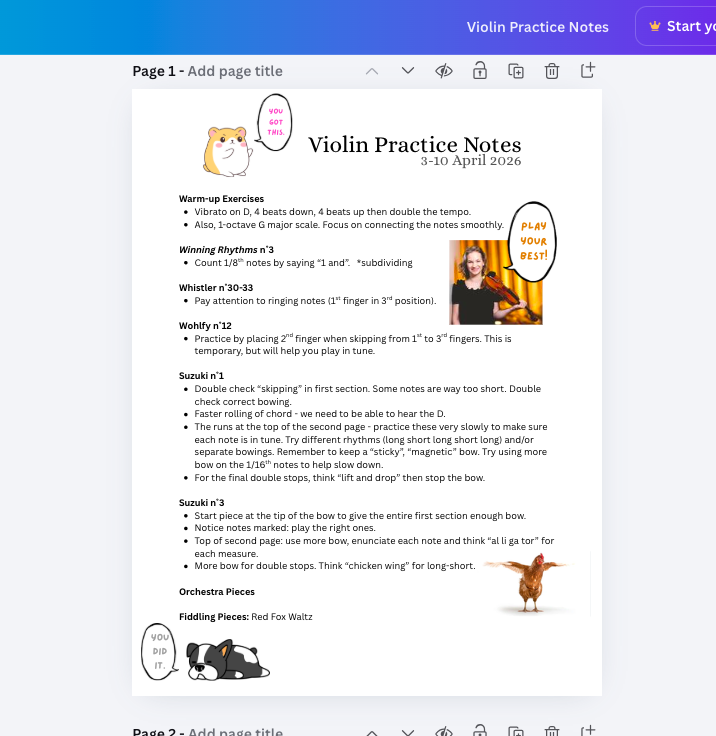
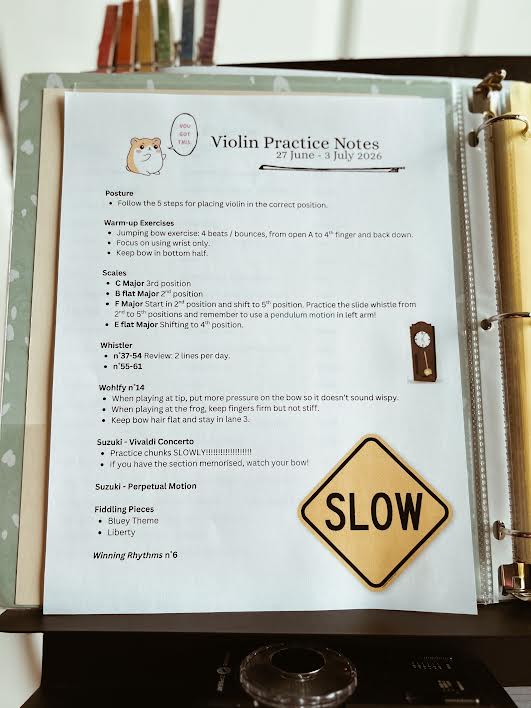
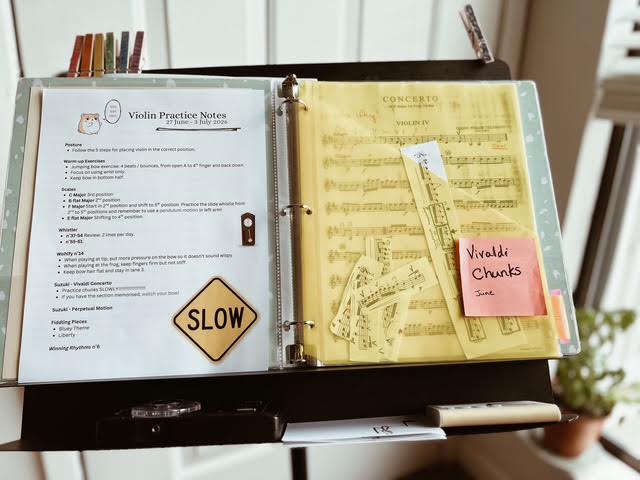
This sheet that I type up is basically the structure of her practice session every day during the week. It starts with a warm-up, then lists each book or exercise that needs to be covered. Not only do I have the books and pages listed, but also reminders of what the teacher said to focus on. For example, during this exercise, pay attention to your bow arm and making the pendulum motion. I also will give specific instructions for some of the exercises, like “5 repetitions of this exercise”, “just practice the chunks in your folder, not the entire piece”, or “set the metronome to 90”. I then try to end the list with the most fun piece she’s working on – usually a fiddle piece.
I try to get really specific with how the pieces and exercises should be practiced so my daughter knows what to do. Otherwise, if you have young musicians, you know their idea of practicing a piece is playing it through one time. As fast as possible.
3. I Mark Up the Music
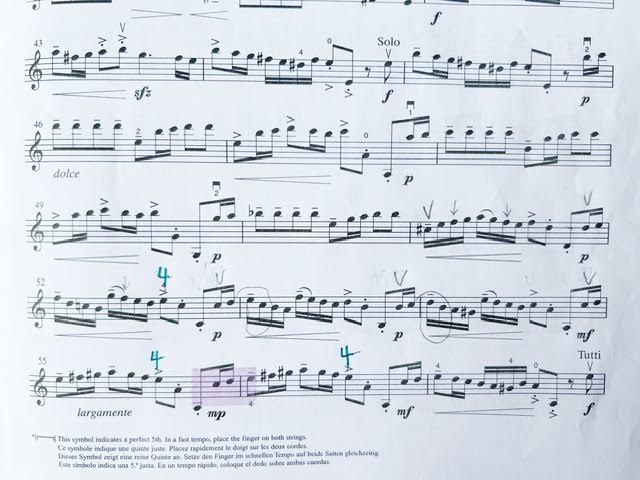
Based on the lesson notes, I will open my daughter’s music books and either go over the teacher’s marks with a colourful pen or write something in myself (star, asterisk, arrows, fingerings, circle a dynamic marking, etc). Sometimes I will wait to do this until I hear her practice over the next day or two to see if the teacher’s reminder during the lesson was enough or if she really needs the music marked. One thing I try to remind my daughter is that less is more. If the music is marked up everywhere, nothing will stand out. I try to save the colour and special marks for those one-off notes that just keep tripping her up.
4. I Break Difficult Passages into Chunks
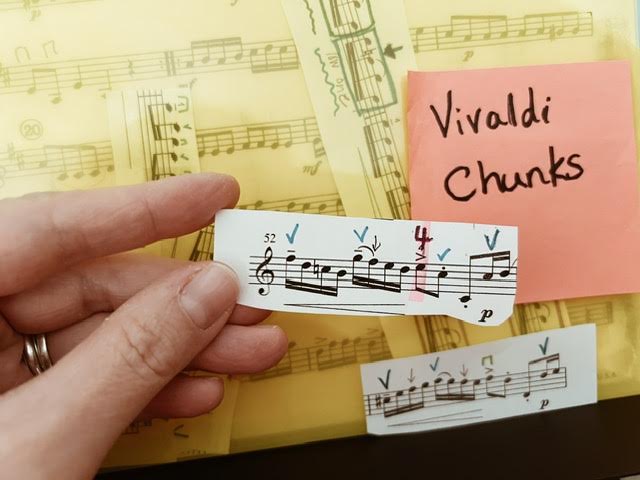
In The Talent Code there is a chapter about the Meadowmount School of Music and it talks about chunking music. It’s essentially a way of breaking down a difficult passage into its smallest components and learning those in isolation before putting it back together.
So, copy the page with the difficult lines. Cut the difficult part out. Now, divide those lines into even smaller chunks. It can be as large as a few measures or as small as two or three notes together. It could literally be just the shift between one note and another in a different position. Finally, mix them up. Do NOT practice them in order. That defeats the purpose. Your brain needs to see that one measure out of context so it’s not tempted to go into autopilot. That’s the secret. That’s how you lean into the difficult passages and break them down.
5. Everything Lives on the Music Stand
So in addition to music books, my daughter now has a list that includes (1) what needs to be practiced, (2) what needs to be focused on for each of those pieces or exercises, as well as (3) suggestions or instructions for how to practice them. She has a folder for any chunks of music that have been cut out. And of course, a metronome, tuner, pencils, colourful pens, and flashcards.
6. The Goal Is Independence
Now, when my daughter goes to practice violin, she not only has a stack of books, but she has a very clear list of what needs to be practiced (like book and page numbers), how to practice it (like number of repetitions), and what to focus on when she’s practicing (like “watch out for your bow to slide out of lane 3”). Having a to-do list for practice sessions also eliminates the “Where do I start?” question and the “Am I done yet?” question.
Now that my daughter is getting older, she wants to be more independent, and that includes things like music practice. Don’t get me wrong, she still likes me to listen to her. But having a list gives her more ownership of her practice habits. And the real beauty of helping her towards more independence is that I can walk away from her during a practice session and she can keep going. My younger children are getting older and need more attention. I can walk away from the music stand to help my son with a worksheet or give my youngest a bottle and I know that my daughter does not have to stop practicing to wait on me. A few minutes of my time on Friday evening and I have more freedom and time during the rest of the week.
Isn’t This is All Too Much Work?
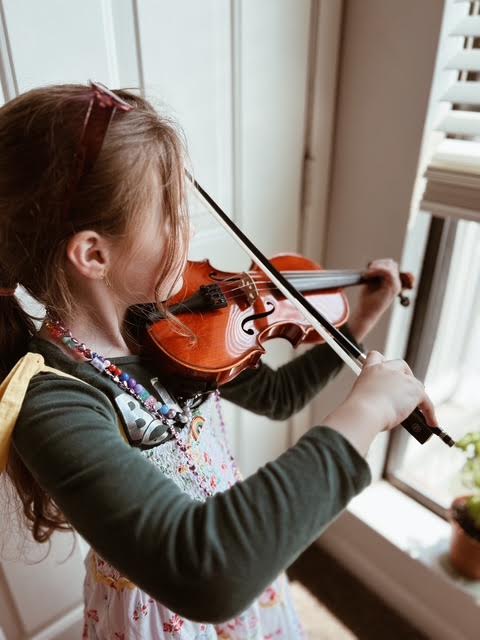
My goal isn’t simply to help my daughter practice more. It’s to help her gradually take ownership of her own practice. Every Friday evening, I spend a little time organizing the week ahead so that by the next day she knows exactly what to do. As she’s gotten older, that preparation has given her more confidence and given me more freedom to help my younger children. That’s a trade I’ll gladly make every week.
Keep Reading About…
Effective tips for practicing with your young musicians at home
Shinichi Suzuki himself – I reviewed a great biography of him


Leave a Reply