This was my first year using a truly structured theology course as opposed to just read alouds from whatever Bible story book seemed the most age-appropriate for my oldest. But for third grade, I went ahead and invested in Christian Studies I from Memoria Press. And to go ahead and answer the question, yes. Yes, Christian Studies from Memoria Press is worth the time and money to add to your classical homeschool routine. Like most of my textbook review posts, I start with why I chose this particular curriculum, but you can scroll down to the bottom for the TLDR section where I list the pros and cons.
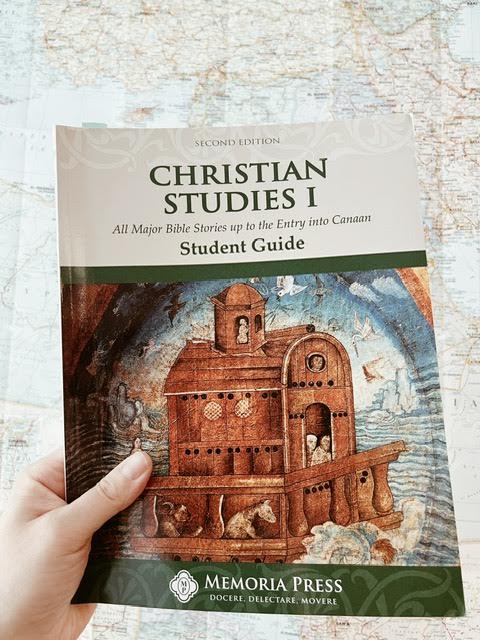
Why Memoria Press for Theology?
Memoria Press was not around when I was a homeschool student. I grew up with Abeka and Bob Jones University Press theology curriculum and I don’t have any real complaints about either one. However, when it came time to choose what to use with my daughter, I decided to go with Memoria Press for two reasons.
Reason 1: Academic Mastery
Unlike other theology curriculum I’ve come across, Christian Studies is not trying to serve as a devotional book. Like other Memoria Press curriculum, the focus is on mastery of the material. It’s not trying to push a particular denomination’s view of the Bible or package every story into a morality tale. Instead, it focuses on facts. Names, dates, places, etc. Believe what you want about the significance of the Abrahamic Covenant, but where is it talked about in the Bible? When did it happen? Where exactly is this promised land on the map? You have to know the facts before you can develop an educated opinion about them. Mastering the foundations of the Bible – what happened, when and where – is critical to being able to study more in-depth.
Reason 2: Curriculum Consistency
There is something to be said for sticking to one curriculum for your homeschool, or at least as few as possible. If it comes down to having to choose between two great options, I would go with the textbook that is already part of the curriculum I am using. It’s simply more efficient. And if you know anything about me from this blog, it’s that I’m all about efficiency and how to be as productive as possible. Once you learn how the Memoria Press curriculum works – how the teacher manuals are laid out, what is expected on exams, etc. – and get into a routine with their schedule, teaching the material becomes quite easy. You can focus on the content of what you are teaching and waste less time just trying to stay organised.
Why Study the Bible Academically?
So why study the Bible academically? Isn’t reading the Bible enough? Why should your elementary student study it like he would mathematics or world history? Personally, I believe that Christians should be Biblically literate. They should know what they say they believe. And that cannot happen without actually studying the Bible as opposed to just reading it. Reading a few verses every morning and reading a devotional book is not studying the Bible. I’m sorry, but no, it doesn’t count. If you want to know what the Bible says, you have to read it and you have to study it. You have to break it down, organise the information, learn the context. And learning that context is going to require studying the time, the languages, the cultures. This takes effort. And no, you’re not going to get it all from this Memoria Press curriculum. However, it’s a great place to start for a third grader. It lays a solid foundation of facts to build on in future.
Nowadays, it seems a lot of parents are assuming their kids are getting this basic foundation in Sunday School and the truth is, most are not. I have been around several Christian homeschool families whose kids do not know the books of the Bible or cannot even identify the Jordan River on a world map. If faith is important to your family, why not take more responsibility for educating your kids on the Bible and not simply reading it to them?
What does Christian Studies I cover?
The book I’m reviewing here is volume I of IV, which covers Creation through Israel’s entry into the Promised Land. The first two textbooks in this series cover the Old Testament. The third textbook in the series covers material in the New Testament and the fourth textbook covers the entire Bible chronologically. Volumes I through III cover the entire Golden Children’s Bible – the Bible storybook this textbook series is designed around.
Lesson Format
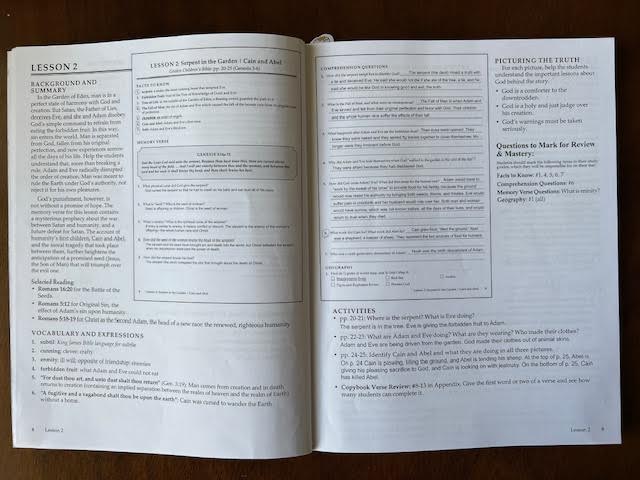
With all of the Memoria Press curriculum I have used so far, one lesson is meant to last one week. At first glance, they seem really short. There is only a two-page spread for each lesson. A fast writer could easily do those two pages in one sitting. That being said, there are several ways to dig deep and get a lot out of each week. There is a lot of information and your student will probably spend a lot of time drilling flashcards. At least, that’s what works for us.
Memoria Press sells a Bible story book called The Golden Children’s Bible that they have reading pages for in this textbook. For our first semester, I subbed in a Bible storybook I already had because I was trying to save money. I came to regret it. It was a lot of extra work. Usually, the storybook I had and was trying to use didn’t cover enough of the Biblical content. It was too watered down and I was constantly having to add material that was going to be tested on, especially vocabulary. The vocabulary in The Golden Children’s Bible is much closer to King James English and less juvenile, while also being easily readable. It really is a great investment and I’m glad I went ahead and bought it for second semester.
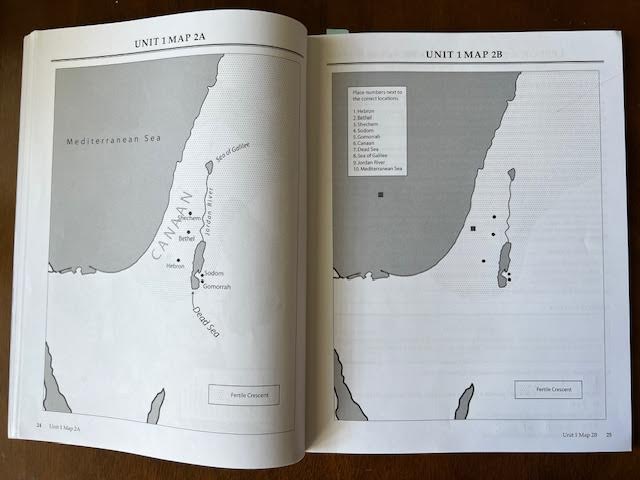
In the student textbook itself, there are about 10 facts to know from each of the readings, followed by a memory verse for that week with comprehension questions about that verse. Then there are about six short-answer style comprehension questions about the entire reading passage. And these are followed by places to know on the map that were mentioned in the reading.
Evaluation
After every five lessons, there is a review lesson and then a test. The tests are very comprehensive and include identifying characters, defining vocabulary (specifically from The Golden Children’s Bible), geography, and a memory verse. The final exam is cumulative, so there is an incentive to continually review older material. I appreciate that a lot of the test questions are “identify” and have my daughter choose from a large pool of answers as opposed to having to remember exact spelling of all of these Biblical names. Again, writing (neatly) is still quite a bit of effort for my student, so having the tests, at least for volume I, not require a ton of free response answers is great.
How We Use Christian Studies I in 3rd Grade
Monday is the day we do the reading and there are usually lots of questions from both my 3rd grader and her 3-year-old brother who has been listening intently. On Tuesday, my daughter and I review the story, then look at the memory verse for the week and talk about it. Because she is still doing AWANAs and memorising lots of verses, I don’t actually assign the memory work in this curriculum. But we go over the verse together and answer the questions. On Wednesdays, we work through the comprehension questions together. Thursdays are for either finishing up comprehension questions and/or reviewing the map. If there is no test this week, Fridays are just for drilling all of the flashcards we’ve made up to this point.
Every week, I make flashcards for the important facts to know and vocabulary (marked in the teacher manual as what will be tested on later). These flashcards get reviewed whenever my daughter is left to her own devices and needs to be working on something. When she’s older and writing isn’t such a heavy lift for her, she’ll be making her own flashcards. For now, it’s more time efficient for me to make them. They’re a great way to study for tests, have independent work for her when I get called away during lesson time and make it easy to drill the important stuff on Fridays. This class literally takes minutes a day and some weeks, it’s only a 4-day class for us.
TLDR: Pros vs Cons
To sum up this Memoria Press Christian Studies I review, here are the pros and cons of buying this curriculum for your theology course:
PROS
- Mastery of the facts is the objective. Like all Memoria Press curriculum I’ve used so far, you’re expected to drill and learn the facts.
- Geography isn’t left out. Instead of just showing where places from the reading are on the map, your student is expected to learn these and identify them on a map.
- Memory Verses. If you’re not already memorising Bible verses at home, it’s great that memory work is incorporated into this curriculum.
- Timeline awareness. There is an emphasis on learning the major moments of Biblical history in chronological order. For example, did the Tower of Babel happen before or after Noah’s Ark?
- Books of the Bible. Students are expected to know the books of the Old Testament in order, correct spelling and be aware of which books are part of the law, versus books of wisdom or the prophets, etc. If your kid is not already learning this in Sunday School or AWANA, having this covered in Christian Studies makes sure your student is getting a thorough education.
CONS
- Geared towards a particular Bible storybook. This doesn’t have to be a con, but if you’re like me and already have several Bible storybooks floating around at home, it might be hard to justify buying yet another for this course. That being said, having the one they recommended makes teaching this curriculum so much easier!
Who would benefit from Christian Studies?
- The Christian teacher who wants to teach the Bible academically.
- The student and teacher who enjoy read-aloud time together.
Have you used this homeschool theology curriculum? Anything you would add to this Memoria Press review?
Keep Reading About…
Other Memoria Press curriculum reviews: First Start French I, D’Aulaires’ Greek Myths


Hi there. Thank you for your review. Are you doing the two-year track for this or the one year track?
Hi Alexis, I was able to finish this in one academic year with my 3rd grader, so we’ll be starting Christian Studies II in September for 4th grade. I forgot Memoria Press suggested it as 2-year track until you made that comment. (I might have to edit my blog post and clarify this, thank you!) But one lesson per week was easily doable for us. I can’t imagine stretching it to 2 years.