In this post, I’m sharing my thoughts on our third-grade classical homeschool curriculum choices that I did with my 6/7 year old this 2025-2026 academic year. If you’re planning a classical third-grade homeschool year, here’s everything we used, what worked, what didn’t, and a few links to more in-depth curriculum reviews.
Our 3rd Grade At-a-Glance
Student Age: 6–7 years old (young third grader with a December birthday)
Homeschool Style: Classical Christian
Schedule: Traditional school year (Sept–May) + light summer school
Math: accelerated pace using multiple curricula
Foreign Languages: French, Latin
Music: Violin (Suzuki), orchestra
Extracurriculars: Taekwondo (3x/week), Ballet
This Year’s Focus: Building strong mathematical foundations, introducing Latin, and continuing consistent progress in French and violin.
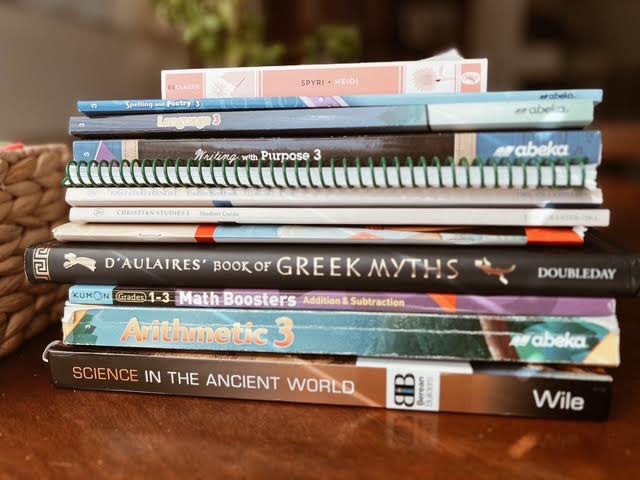
Third Grade Homeschool Curriculum Overview
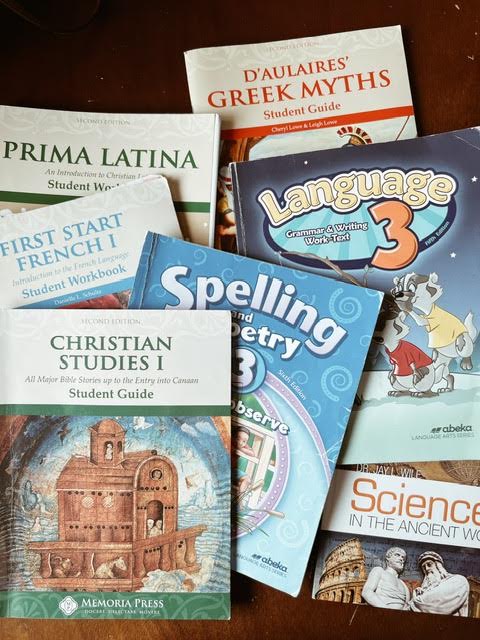
- Theology – Christian Studies I from Memoria Press
- Mathematics – Abeka & Saxon
- French – First Start French I from Memoria Press
- Latin –Prima Latina from Memoria Press
- English – Abeka
- History/Classical Studies – D’Aulaires’ Greek Myths from Memoria Press
- Science – Science in the Ancient World by Berean Builders
Theology
This was our first year of formal Bible study and I was really impressed with Christian Studies I from Memoria Press. It was very academic and helped my daughter build a solid foundation in Biblical knowledge, from names and dates to Holy Land geography. I love how Memoria’s course is very objective. It doesn’t matter if you’re Catholic or Protestant, this is just a study of what the Bible says, not how it is interpreted. For example, What does the Abrahamic Covenant mean and how should we interpret it today? This course will not try to answer that question. Instead, it will teach you who Abraham was, what time he lived, where he lived, when the covenant was made, etc. It covers that foundational, factual knowledge that every Christian should strive for.
Mathematics
For math this year, my daughter finished Arithmetic 3 from Abeka (their 3rd grade textbook) midyear. By the end of the textbook, she had all of her times tables memorised (through 12) and was really enjoying the book. Abeka is known for their colourful, kid-friendly textbooks. But instead of sticking with Abeka, I decided to make the switch to Saxon 5/4. That’s Saxon’s 4th grade math curriculum for students on grade level (or slower paced 5th graders). I had read reviews that Abeka was overhauling their math curriculum and their 4th grade textbook had already been re-done. And I wasn’t in the mood to experiment. Not with math. So I decided to go ahead and switch to a publisher I knew well (I used Saxon when I was homeschooled).
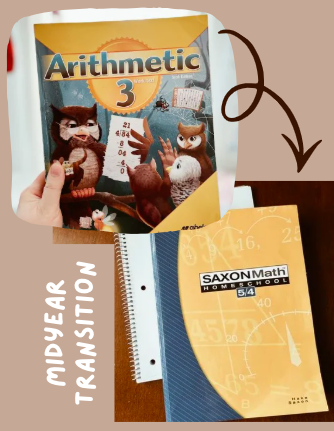
Unfortunately, I’ve noticed that Saxon’s 4th grade text isn’t hitting multiplication right away and my daughter’s times tables math facts have started to slip. I’m going to write a full review on Saxon 5/4 soon. But for now, I am currently reinforcing math facts over the summer with flashcards and speed drills. The Saxon 5/4 curriculum includes speed drills, however, the ones for the beginning of the textbook only cover addition and subtraction math facts. I know that this gap is normal when switching curriculum and I would have staggered the transition (phased out Abeka while slowly introducing Saxon) if I had had the budget at the time. But over the summer, we slowed down the pace considerably (half an hour every day, Monday through Friday) and are making sure we review all the math facts.
French
Despite my optimism in the second semester of second grade, we did not in fact finish First Start French I. So this textbook carried us through for our third grade homeschool curriculum. To be fair, it was more of a spine – a jumping off point for learning vocabulary and grammar. I didn’t expect my 6-year-old to learn all of the content to 100% and I didn’t test her over the material. I’m trying to keep French in the category of fun and increase her familiarity with the language instead of making it just another box to check on her daily assignment sheet.
My husband was initially concerned that French and Latin would be too much for the same year. But it has provided a context for understanding verb conjugations before starting Latin. And it is much easier to show the progression from Latin, to French, to English for derivatives. There is so much overlap between French and Latin – they work quite well together.
Latin
Third grade was our first year of Latin study. I was very happy with our choice of Prima Latina, despite being listed in the Memoria Press catalogue as geared towards 2nd graders. It was just the right pace to introduce the language into our rigorous homeschool schedule without being overwhelming.
English
For English, I continued to use Abeka for grammar, cursive & creative writing, and spelling. I talked about this in a second grade review of their English curriculum, but I’m partial to Abeka’s English program because I used it as a student and it is how I learned to read and write. I’m sure there are other great programs out there, but I know Abeka, it’s familiar, and I could easily teach the material without having to learn a new curriculum.
Their grammar textbooks are excellent because they include a lot of practice with grammatical concepts. It’s a spiral approach, with a lot of review built in. Their cursive writing textbook also doubled as an introduction to creative writing. If money were no option, I would have ordered the teacher manual for Abeka English once I saw how little instruction there was for their creative writing material this year. However, we made it work. The grammar textbook taught paragraph structure and the creative writing pages gave her several opportunities to practice writing her own paragraphs. And this was a gradual process – with several lessons just practicing writing topic sentences and concluding sentences. Scaffolding is the word that best describes this approach.
Spelling was typical – lists and spelling tests. And I didn’t schedule “literature” for my third grader. I was more concerned about her building a consistent, daily reading habit. At the start of the semester, I was a bit concerned that she didn’t enjoy reading, or was having a difficult time, but it turned out she just really did not enjoy the book I had chosen (sorry, Heidi). Once she read Matilda, it was all over. The fire had been lit. Her reading has gotten faster and I can tell by asking her questions about what she’s reading (since I’ve read most all of her books already) that her comprehension is also good. I’m really happy with this approach and don’t plan on using a formal literature course for 4th grade either.
Classical Studies (History)
We decided to take a break from the Mystery of History series and focus on Greek mythology, which is the Memoria Press recommendation for third grade. I like Mystery of History as a shallow overview of history that lends itself well to further study. So we will pick back up with volume 3 of the series for 4th grade to help my daughter get a big picture overview of history without getting lost in the weeds of Greek history (on the schedule for 4th grade as well). Like the previous years, I will use it as a read-aloud for meal times and not an academic subject per se that will be tested on. I have project ideas to make it fun and interesting, but those will fall in the realm of extras if time permits.
Science
Because I combined multiple science curricula for second grade, we ended up not finishing Science in the Ancient World. And this was a shame, because I really appreciated this textbook. So I decided to do it over for third grade. The lessons we reviewed really helped my daughter solidify some abstract concepts and we were able to finish the course. And I decided to continue the series for 4th grade. As much as my daughter loves science, I would really like to lean into as much hands-on learning as I can and I know this course will challenge me (and my budget). But it will be worth it.
How We Leverage Summer
I’m writing this now that summer is halfway over, so I can tell you what’s been working for us in terms of building the bridge between third and fourth grade. We take our break seriously, so summer school is very chill. I live by timers and am not concerned with getting a certain number of pages or lessons done. It’s all about consistent daily habits. I have a whole post about our summer routine, but here are the highlights as they relate to building on third grade:
Summer Math – 30 minutes
Like I said above, we really needed to lean in on math facts that had been learned during Abeka’s Arithmetic 3 and weren’t being used in Saxon 5/4 yet. So we’ve started each math period going through multiplication flashcards (about 5 minutes). We then set a timer and she works in her Saxon textbook for 25 minutes. When the timer goes off, she finishes the problem she was working on and then we shut the books.
Summer Reading – 30 minutes
This is literally half an hour of reading whatever she wants. She has started several series, from Harry Potter and Percy Jackson to Nancy Drew. To make this more fun, I have a reading challenge calendar for the wall. Each day she does her reading, she puts a sticker on the day. If she doesn’t miss a day, we have a bookstore and sweet treat date before school starts.
US Geography – 30 minutes
This is a perfect example of how I use the summers to get ahead. It’s important to know geography, but I don’t really want to spend precious time during the school year working on it. My daughter loves maps and anything related to geography, so we decided to knock out US geography (from Memoria Press) this summer before fourth grade.
Violin Practice
Some days, negotiating with a timer is required to get my daughter up and practicing her violin. If you’re a musical homeschool family, you know the deal. You can’t take summers off with an instrument. They just don’t work that way, unfortunately.
Keep Reading About…
The ultimate summer checklist for working homeschool moms
How to get back into the homeschool routine after summer break
Ideas on how to encourage a literary summer


Leave a Reply